
After completion of this Lesson (RNA and DNA), the students will be able to:
- Differentiate between RNA and DNA based on their structure & function.
- Tell the importance of DNA in different research works.
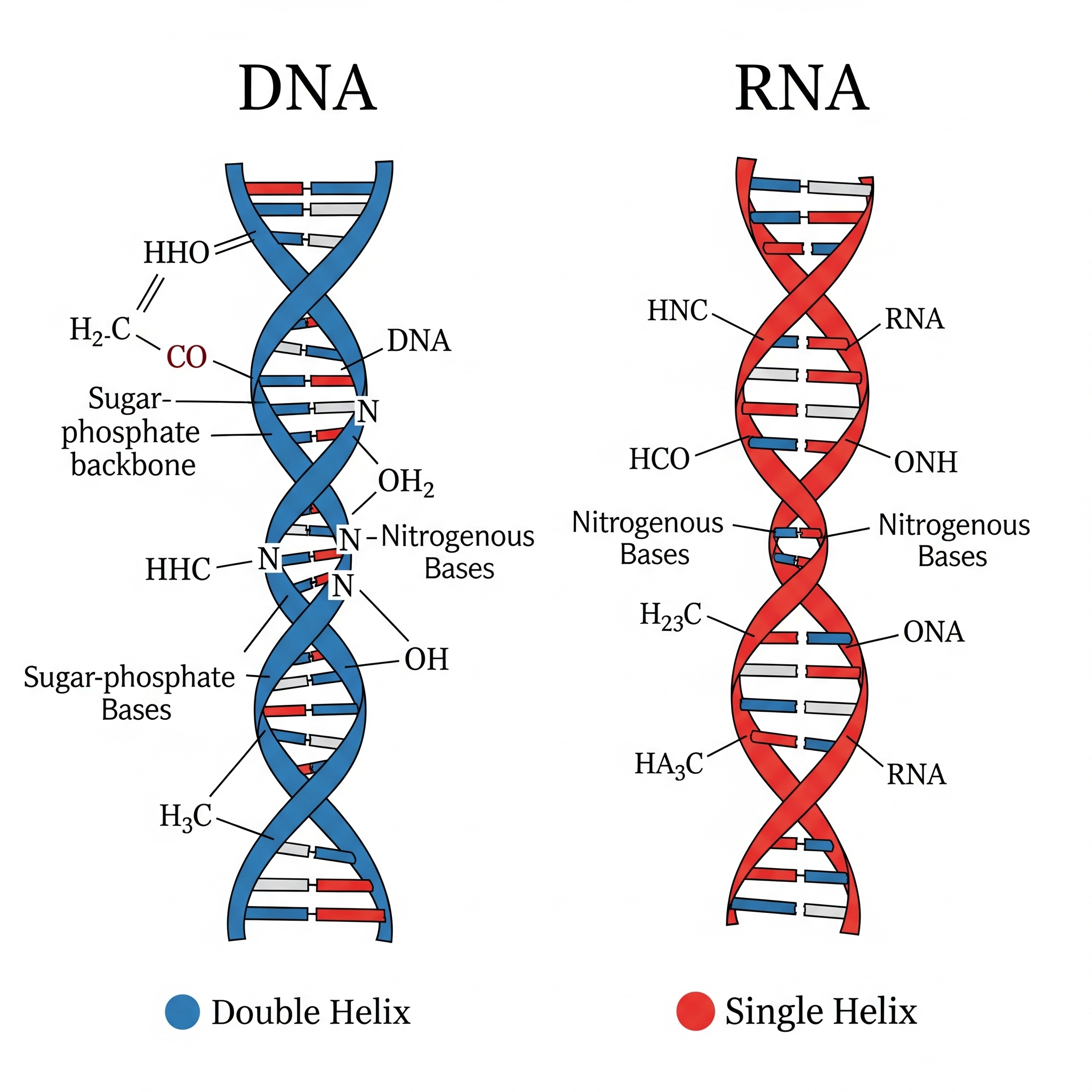
🧬 Difference Between DNA and RNA (Structure & Function)
| Feature | DNA (Deoxyribonucleic Acid) | RNA (Ribonucleic Acid) |
|---|---|---|
| Full Form | Deoxyribonucleic Acid | Ribonucleic Acid |
| Structure Type | Double-stranded helix | Single-stranded chain |
| Sugar Component | Deoxyribose sugar | Ribose sugar |
| Nitrogen Bases | Adenine (A), Thymine (T), Cytosine (C), Guanine (G) | Adenine (A), Uracil (U), Cytosine (C), Guanine (G) |
| Location in Cell | Mostly in the nucleus, some in mitochondria | Found in the nucleus and cytoplasm |
| Stability | Very stable due to double-strand structure | Less stable, easily broken down |
| Function | Stores genetic information and passes it from generation to generation | Helps in protein synthesis by carrying messages from DNA |
| Lifespan | Long-lived, remains unchanged throughout life | Short-lived, degrades after its job is done |
| Types | Only one type | Three types: mRNA, tRNA, rRNA |
✅ Key Summary:
-
DNA = Blueprint of life (permanent storage)
-
RNA = Worker that helps build proteins (temporary messenger)
🧬 Importance of DNA in Different Research Works
🔬 1. Medical Research
-
Disease Diagnosis: DNA analysis helps identify genetic disorders (like cystic fibrosis, thalassemia, and cancer).
-
Personalised Medicine: Doctors can tailor treatments based on a person’s DNA (precision medicine).
-
Gene Therapy: Damaged or missing genes can be repaired or replaced using DNA research.
🧪 2. Forensic Science
-
DNA Fingerprinting: Helps identify suspects or victims from blood, hair, or skin cells.
-
Crime Solving: Matching DNA samples from crime scenes with people.
-
Paternity Testing: Confirms biological relationships through DNA.
🌱 3. Agricultural & Plant Research
-
Genetically Modified Crops (GMOs): DNA is altered to produce crops that are resistant to pests, diseases, or harsh environments.
-
Trait Selection: Identifies DNA linked to better yield, drought resistance, or nutritional value.
🐄 4. Animal Breeding & Veterinary Science
-
Breed Improvement: DNA helps select animals with desirable traits (like more milk production).
-
Disease Resistance: Detects genes related to immunity, helping breed stronger animals.
🧬 5. Evolutionary & Ancestral Research
-
Tracing Human Origins: DNA comparison across populations shows how humans migrated and evolved.
-
Species Relation: Shows how closely animals or plants are related through shared DNA.
🧫 6. Biotechnology & Genetic Engineering
-
CRISPR Technology: Edits DNA precisely to fix genetic problems.
-
Synthetic Biology: Designs new organisms using artificial DNA.
🧍 7. Population & Environmental Research
-
Biodiversity Studies: DNA is used to identify species, even from soil or water samples (environmental DNA).
-
Tracking Endangered Species: Helps monitor and protect wildlife using genetic data.
🧠 Summary:
DNA is the foundation of all life sciences. Whether it’s fighting disease, creating better crops, solving crimes, or understanding human history — DNA research plays a central role in modern science and innovation.