
After completion of this lesson (Human Blood Circulatory System -part 1), students will be able to :
- Introduce the human blood circulatory system.
- Describe the structure and function of the human heart, blood, and blood vessels.
- Describe blood circulation in the human body with a diagram.
————————————————————————-
❤️ Introduction to the Human Blood Circulatory System
The human blood circulatory system is a vital transport system that keeps our body alive and functioning. It delivers oxygen, nutrients, hormones, and removes waste products like carbon dioxide and urea.
The heart is at the centre of this system, a muscular organ that works as a pump to circulate blood throughout the body. The blood moves through a vast network of blood vessels, which include:
-
Arteries – carry oxygen-rich blood away from the heart.
-
Veins return oxygen-poor blood back to the heart.
-
Capillaries – tiny vessels where exchange of gases, nutrients, and waste occurs between blood and body cells.
🫀 Main Components of the Circulatory System:
-
Heart – Four-chambered pump (2 atria and 2 ventricles) that pushes blood throughout the body.
-
Blood – The fluid that carries oxygen, nutrients, hormones, and waste.
-
Red blood cells carry oxygen.
-
White blood cells fight infection.
-
Platelets help with clotting.
-
Plasma – the liquid part of blood.
-
-
Blood Vessels – Arteries, veins, and capillaries form a closed-loop system for circulation.
🔄 Types of Circulation:
-
Pulmonary Circulation – Between the heart and lungs (for oxygenation of blood).
-
Systemic Circulation – Between the heart and the rest of the body (to supply oxygen and nutrients).
📌 Functions of the Blood Circulatory System:
-
Supplies oxygen and nutrients to tissues.
-
Removes carbon dioxide and metabolic waste.
-
Helps in regulating body temperature.
-
Transports hormones and maintains pH balance.
-
Defends the body through immune cells in the blood.
The circulatory system is essential for survival, energy, and body defence. Any failure in this system can lead to serious health issues such as heart attacks, strokes, or circulatory disorders.
🫀 Structure and Function of the Human Heart, Blood, and Blood Vessels
1. ❤️ Human Heart
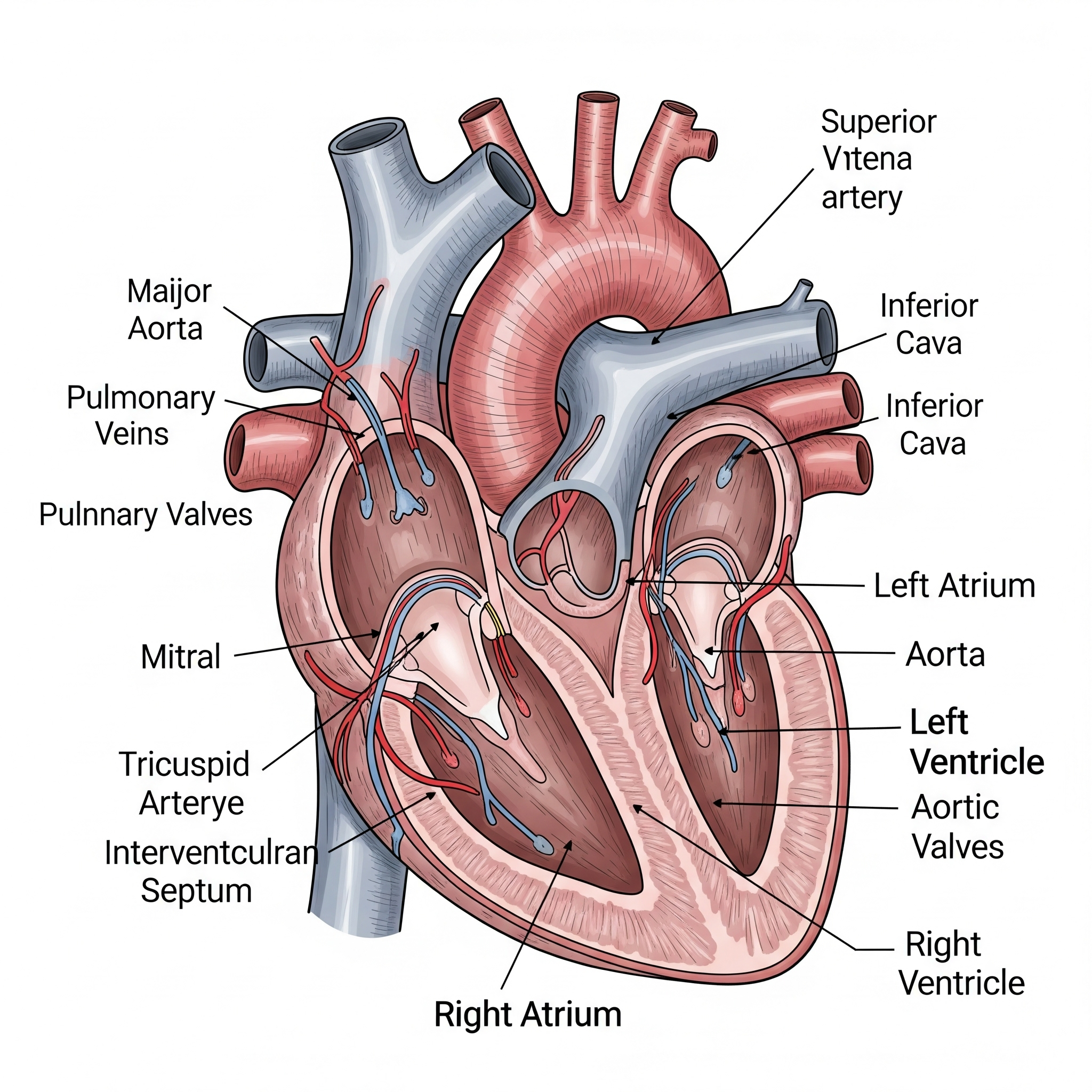
Structure:
-
The human heart is a muscular, four-chambered organ located in the chest cavity between the lungs.
-
It has:
-
2 upper chambers called atria (right and left atria)
-
2 lower chambers called ventricles (right and left ventricles)
-
-
The heart has valves (tricuspid, bicuspid/mitral, pulmonary, and aortic) to ensure one-way flow of blood.
-
The heart is divided by a septum to keep oxygenated and deoxygenated blood separate.
Function:
-
The heart works as a pump to circulate blood throughout the body.
-
It beats about 70–80 times per minute to maintain continuous blood flow.
-
It has two main circulations:
-
Pulmonary circulation – sends deoxygenated blood to the lungs and brings back oxygenated blood.
-
Systemic circulation – sends oxygenated blood to the body and returns deoxygenated blood to the heart.
-
2. 🩸 Blood
Structure:
Blood is a fluid connective tissue made up of:
-
Red blood cells (RBCs) contain haemoglobin and carry oxygen.
-
White blood cells (WBCs) fight infections and diseases.
-
Platelets help in blood clotting.
-
Plasma – yellowish fluid that transports nutrients, hormones, and waste.
Function:
-
Transport of oxygen, carbon dioxide, nutrients, hormones, and waste.
-
Defence against infection (WBCs).
-
Clotting to prevent blood loss (platelets).
-
Regulation of body temperature and pH.
3. 🩻 Blood Vessels
There are three main types of blood vessels:
A. Arteries
-
Structure: Thick, elastic walls to handle high pressure.
-
Function: Carry oxygen-rich blood away from the heart (except the pulmonary artery).
B. Veins
-
Structure: Thinner walls often have valves to prevent backflow.
-
Function: Carry oxygen-poor blood back to the heart (except the pulmonary vein).
C. Capillaries
-
Structure: Tiny, one-cell-thick vessels connecting arteries and veins.
-
Function: Site of exchange of oxygen, carbon dioxide, nutrients, and waste between blood and tissues.
🔁 How They Work Together:
-
The heart pumps blood through the blood vessels.
-
Arteries carry blood away from the heart to the organs.
-
Capillaries allow the exchange of gases and nutrients.
-
Veins bring the blood back to the heart.
🔄 Blood Circulation in the Human Body
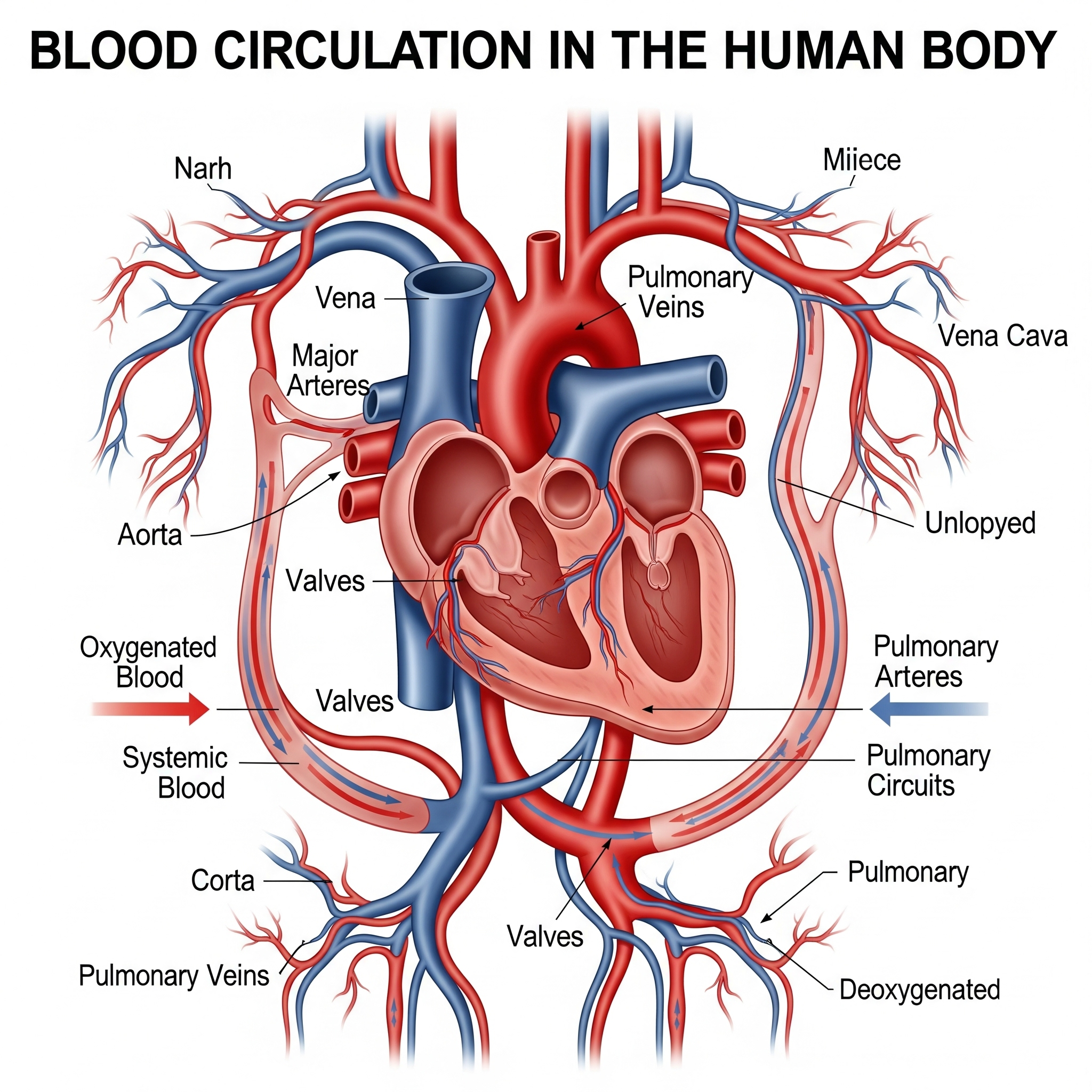
The human circulatory system follows a double circulation pattern. This means blood passes through the heart twice during one complete cycle:
1. 🫁 Pulmonary Circulation (Heart → Lungs → Heart)
-
Begins when deoxygenated blood from the body returns to the right atrium of the heart.
-
Blood is pushed into the right ventricle.
-
The right ventricle pumps this blood through the pulmonary artery to the lungs.
-
In the lungs, carbon dioxide is released and oxygen is absorbed.
-
The now oxygenated blood returns to the left atrium of the heart via the pulmonary veins.
2. 💪 Systemic Circulation (Heart → Body → Heart)
-
The oxygen-rich blood moves from the left atrium to the left ventricle.
-
The left ventricle pumps it into the aorta, the largest artery.
-
Blood is distributed to all body organs through arteries.
-
After delivering oxygen and nutrients, blood collects waste and CO₂, becoming deoxygenated.
-
This blood returns to the right atrium via veins, mainly the superior and inferior vena cava, completing the cycle.
🫀 Key Functions of Circulation:
-
Delivers oxygen and nutrients to cells.
-
Removes wastes like carbon dioxide and urea.
-
Maintains body temperature, hormone distribution, and immune response.
🫀 Heart Beat – Explained Simply
The heartbeat is the rhythmic contraction and relaxation of the heart muscles that pump blood throughout the body. It is controlled by electrical signals generated within the heart.
🔁 Steps of a Heartbeat
-
Atrial Contraction (Atrial Systole)
-
The atria (upper chambers) contract.
-
Push blood into the ventricles (lower chambers).
-
-
Ventricular Contraction (Ventricular Systole)
-
The ventricles contract.
-
Blood is pushed from:
-
Right ventricle → lungs (via pulmonary artery)
-
Left ventricle → body (via aorta)
-
-
-
Relaxation (Diastole)
-
All chambers relax.
-
The heart refills with blood from the body and lungs.
-
⚙️ Who Controls the Beat?
The heartbeat is controlled by a natural pacemaker called the SA Node (Sinoatrial Node) located in the right atrium.
It sends electrical signals that coordinate the heart’s contractions.
❤️ Normal Heart Rate
-
For adults: 60–100 beats per minute (bpm)
-
Can increase during exercise, excitement, or stress
-
Slower in athletes
🎯 Importance of Heartbeat
-
Maintains blood flow to supply oxygen and nutrients
-
Removes carbon dioxide and waste
-
Supports brain, organs, and muscle function
🧠 Bonus Fact
Each “lub-dub” sound of the heartbeat is caused by the closing of heart valves!
💉 Blood Pressure
Blood pressure is the force of blood pushing against the walls of arteries as the heart pumps. It’s an essential measure of how well your heart and circulatory system are functioning.
📊 What Are the Two Readings?
Blood pressure is written as two numbers, for example:120 / 80 mmHg
-
Systolic Pressure (120)
-
The top number
-
Measures pressure when the heart contracts and pumps blood
-
-
Diastolic Pressure (80)
-
The bottom number
-
Measures pressure when the heart relaxes between beats
-
A sphygmomanometer is used by doctors to measure a person’s blood pressure accurately.