
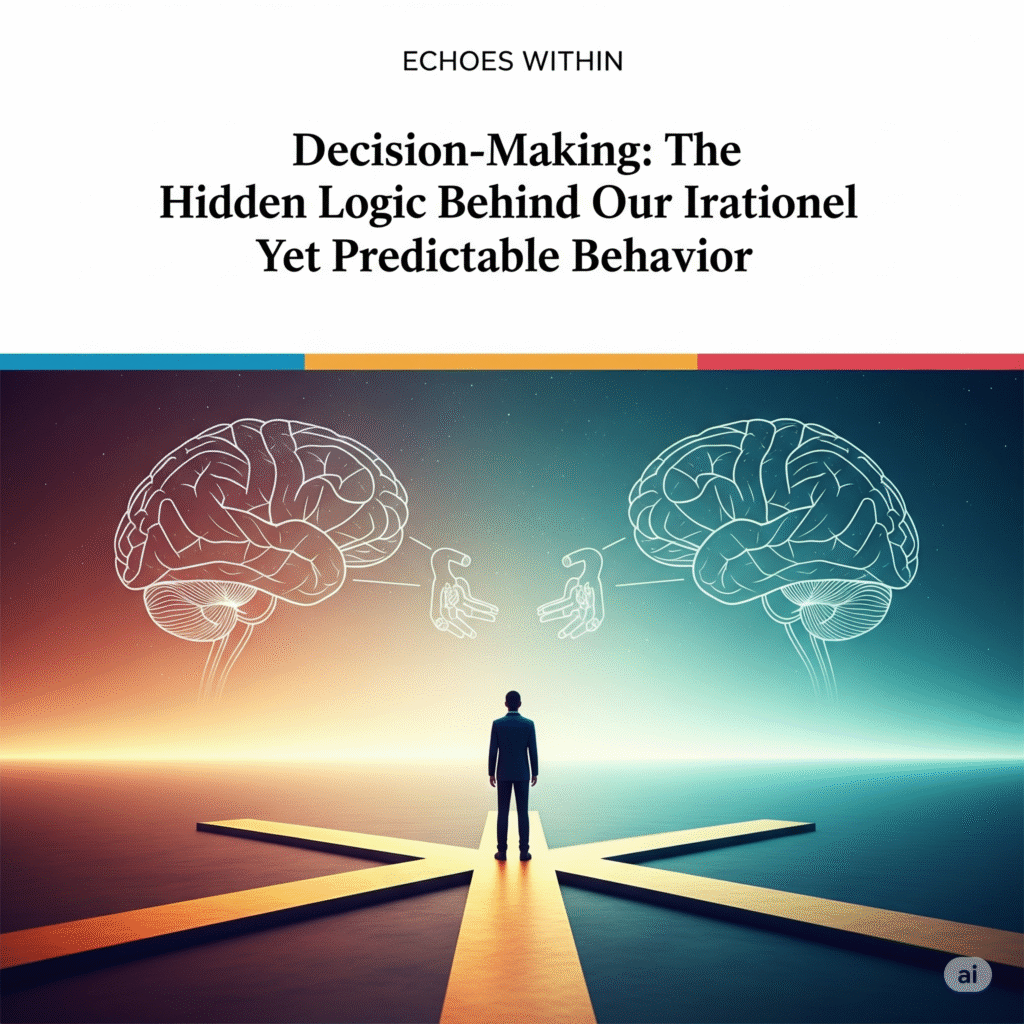
Decision-Making: Irrational Yet Predictable Behaviour
Have you ever made a decision and later asked yourself, “Why did I do that?” You’re not alone. Many of our daily choices don’t seem to make sense. We eat junk food when trying to lose weight. We spend money when we should save. These behaviours feel irrational, but interestingly, they’re not random. They follow clear, predictable patterns. Let’s explore the surprising reasons behind our choices and the hidden logic that drives our actions.
“Why did I do that? What is the science behind this?”
We often make choices that feel strange or even silly later. Like staying up too late, eating unhealthy food, or avoiding important work. These decisions seem irrational, but they’re not just random mistakes. They happen for real scientific reasons.

1. We Don’t Always Think Rationally — and That’s Normal
First, it’s important to know that we don’t always make decisions using logic alone. While we like to believe we are logical beings, our emotions, past experiences, and mental shortcuts (called cognitive biases) play a huge role in how we think.
For example, when we’re hungry or tired, we’re more likely to make impulsive decisions. When we’re scared, we avoid risks—even if taking one might help us in the long run. These patterns might seem irrational, but they’re our brain’s way of keeping us safe and comfortable in the short term.
2. Emotions Drive Many of Our Choices
Emotions influence our decisions more than we realise. Let’s say you feel anxious during a job interview. That anxiety might make you speak too quickly or forget your answers. It’s not because you’re unqualified—it’s because fear took over.
Even in daily life, we often choose what feels good instead of what’s best. We might watch Netflix instead of studying. We might avoid a tough conversation to escape discomfort. These emotional decisions seem irrational, but they follow a very human pattern—we seek pleasure and avoid pain.
The Science Behind This: Emotions Often Take the Driver’s Seat
Your decisions are not always based on logic. Emotions like fear, anger, or joy often take over. You might:
Buy something when you’re sad.
Yell in anger and regret it later.
Avoid a big goal because of fear.
This emotional response is part of how your brain keeps you safe. It’s trying to protect you, but it can also misguide you.
3. Our Brain Uses Shortcuts (Biases)
To make fast decisions, our brain uses mental shortcuts, also called heuristics or biases. These help us respond quickly, but they often lead to errors in thinking.
Here are a few common examples:
Confirmation Bias: We focus only on information that supports our beliefs.
Loss Aversion: We fear losing more than we enjoy gaining.
Anchoring Effect: We rely too much on the first piece of information we see.
The Science Behind This: The Brain Tries to Save Energy
Your brain is like a supercomputer, but it’s also lazy sometimes. To save energy, it uses shortcuts to make fast decisions. These shortcuts are called cognitive biases. They’re helpful—but not always accurate.
For example:
You overvalue first impressions (anchoring bias).
You believe what you already think is true (confirmation bias).
You fear losses more than you enjoy gains (loss aversion).
These biases help us save time and effort. But they can also cause us to make choices that don’t seem logical when we look back.
4. Habits Make Our Behaviour Predictable
Even though our decisions feel random, they are often shaped by repeated habits. Once we form a habit—like checking our phone every morning—it becomes automatic. We no longer think about it, and we do it without much effort.
The Science Behind This: Habits Take Over
Much of your behaviour is automatic. Once something becomes a habit, your brain stops thinking much about it. That’s why:
You scroll your phone without noticing.
You eat snacks when you’re bored.
You say “yes” even when you mean “no.”
These behaviours seem irrational, but they follow predictable patterns built from routine.
This is why we keep returning to the same behaviours, even when we know they’re not helpful. Over time, our habits become our routines, and our routines shape our lives.
5. Social Influence Matters More Than We Think
We also copy others, sometimes without realising it. This is known as social proof. When we see others doing something—buying a product, following a trend, or acting a certain way—we often do the same. Why? Because fitting in makes us feel safe.
The Science Behind This: Social Pressure Shapes Your Choices
Humans are social creatures. We copy others to fit in. If everyone around you acts a certain way, you probably will too—even if it doesn’t make sense.
This social proof is a powerful force behind trends, opinions, and even risky behaviour.
This kind of decision-making is especially strong in groups or online communities. That’s why trends spread so fast on social media. Again, it may not always seem rational, but it follows a pattern: people tend to trust what many others are doing.
6. We’re Predictably Irrational
Even though we make mistakes, those mistakes are not random. Experts like Daniel Kahneman and Dan Ariely have shown that human decision-making is irrational, but in predictable ways. This means researchers can often guess how most people will behave in certain situations.
The Science Behind This: You Are Predictably Irrational
You don’t make purely logical decisions. But here’s the twist: our irrationality follows patterns. That means your “strange” behaviour isn’t random—it’s predictable. And if it’s predictable, it can be changed.
Understanding these patterns helps in many areas—from marketing and politics to health and education. It also helps us understand ourselves better and make smarter choices in the future.
The Good News
Understanding the science behind your decisions gives you power. Once you know how your brain works, you can:
Slow down before reacting.
Build better habits.
Handle emotions more wisely.
Think more clearly in tough situations.
Conclusion
At first glance, human behaviour can seem confusing. But when we look closer, we find a clear logic behind even our most irrational decisions. Our emotions, habits, biases, and social surroundings all play a part. The good news? Once we understand these patterns, we can start to change them.
So the next time you ask, “Why did I do that?”—remember, your brain wasn’t broken. It was just following hidden rules. And now that you know the rules, you can start making decisions that truly serve you.
You Can Also Read:
Voluntary Childlessness: Challenging Societal Norms
Polyamory and Open Relationships: Redefining Love in the Modern Age
Extreme Body Modification: Pushing the Boundaries of the Human Form
APA (American Psychological Association) – “The Rationality of Irrationality”
Daniel Kahneman – Thinking, Fast and Slow
A foundational book on how our minds use two systems: fast (emotional, automatic) and slow (logical, deliberate).
Explains cognitive biases and irrational thinking.
Pingback: Building Good Habits: Simple Strategies to Boost Well-Being
Thanks for sharing. I read many of your blog posts, cool, your blog is very good.
Thank you for your sharing. I am worried that I lack creative ideas. It is your article that makes me full of hope. Thank you. But, I have a question, can you help me?