
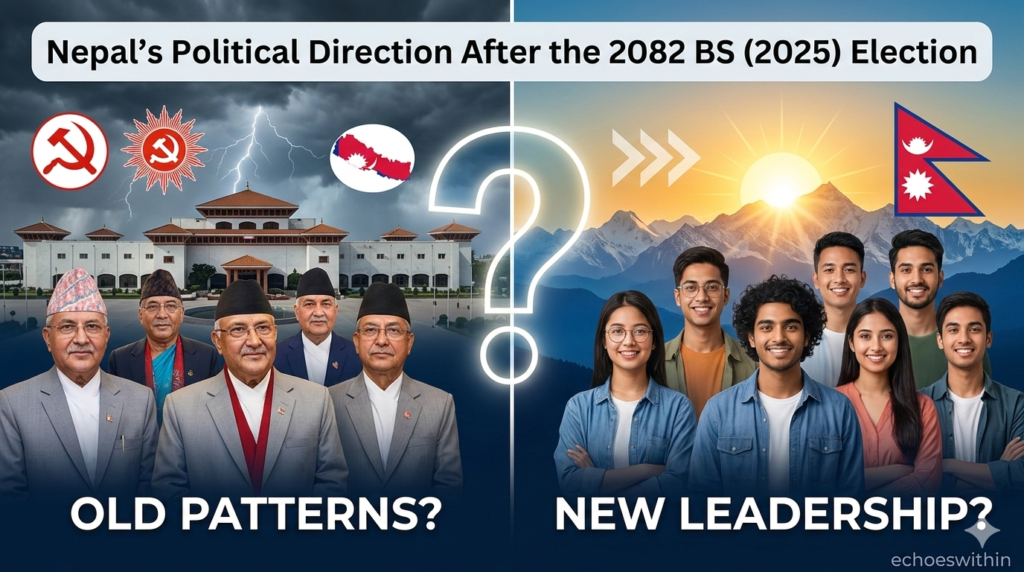
🇳🇵 Introduction: A Nation Reading the Signs After the Election
Following the election held on 2082.11.21 (BS), many citizens in Nepal are asking the same questions:
Is the country truly changing?
Are voters moving away from traditional party loyalty?
Is Nepal searching for a new kind of leadership?
Although final outcomes take time to shape governance, elections often reveal public psychology long before policies change.
🔄 Visible Changes in Nepal’s Political Mood
Firstly, what stands out most after this election is diversification of votes.
Unlike earlier periods dominated by rigid party lines:
Voters appear more experimental
Loyalty seems more conditional
Performance and personality matter more
This shift suggests not confusion, but fatigue with repetitive political cycles.
🌆 The “Balen Effect” and the Craze for a New Political Style
One of the most talked-about phenomena is the continued public fascination with Balen Shah.
Even without direct participation at the national level, his governance style has:
Challenged traditional political norms
Inspired younger voters
Popularized the idea of results-over-rhetoric
As a result, conversations about a “future PM outside old frameworks” have intensified—whether realistic or symbolic.
Importantly, this craze may have indirectly fragmented votes, weakening established party strongholds.
🏛️ Nepali Congress and the Gagan Thapa Factor
Meanwhile, within the Nepali Congress, attention has increasingly centered on Gagan Thapa.
Many supporters view him as:
A reformist voice
A generational bridge
A test of whether internal democracy can work
However, the party still faces a dilemma:
Can it truly transform from within, or will old power structures resist change?
The election results appear to reflect this internal tension.
🪑 KP Oli and the Attachment to the PM Chair
On the other side, KP Sharma Oli continues to symbolize a different reality of Nepali politics.
For some supporters, he represents:
Strong leadership
Political experience
For critics, however, he reflects:
Power centralization
Repetitive leadership cycles
Over-attachment to the Prime Minister’s chair
The election outcome suggests that while his influence remains, public patience may be thinning.
👑 Role of the Former King and Monarchist Supporters
Another noticeable undercurrent is the renewed visibility of monarchist sentiment, associated with Gyanendra Shah and his supporters.
Although not electorally dominant:
Their presence signals dissatisfaction with republican outcomes
Their voice reflects nostalgia for stability and order
Rather than a return to monarchy, this trend likely represents a protest against political dysfunction.
🌏 Influence of Neighboring and Global Powers
No Nepali election exists in isolation.
🇮🇳 Role of India
India remains deeply connected through:
Open borders
Economic ties
Cultural proximity
Its interest traditionally lies in stability and predictability rather than specific personalities.
🇨🇳 Role of China
China’s role is largely strategic:
Infrastructure interests
Regional balance
Long-term connectivity
It tends to favor continuity and state-to-state engagement.
🇺🇸 Role of United States and Other Western Nations
Western involvement often focuses on:
Democratic processes
Institutional stability
Transparency and governance norms
While influence exists, it is generally indirect and long-term.
Overall, foreign countries influence conditions, not ballots.
🧠 What This Election Really Signals
Taken together, the 2082 election appears to signal:
Growing voter consciousness
Declining tolerance for fear-based politics
Desire for accountability over ideology
Importantly, it does not yet signal a complete political transformation—but it does suggest pressure for change.
🔮 Who Will Be the Future PM?
At this stage, any name would be speculative.
However, the election indicates that:
Traditional paths to power are no longer guaranteed
Public legitimacy matters more than internal deals
Performance narratives increasingly shape leadership acceptance
The future PM of Nepal may be decided less by party rooms and more by public trust.
🌟 Final Thought: Transition, Not Revolution
In conclusion, the changes seen after the 2082.11.21 election point to a transitioning political culture, not a finished revolution.
Nepal seems to be saying:
“We are watching more closely now.”
Whether leaders listen—or repeat old patterns—will define the coming years.
💭 Reflection Question
Is Nepal searching for a new leader—
or a new way of practicing politics?
🔍 You Can Also Read:
- Are Nepalese People Feeling Disconnected from Old Politics? Is the Search for a New Face Fueling Support for Balen Shah?
- The Craze of Balen Shah in Nepalese Politics: Criticism, Cultural Sensitivity, and the Vision of a Prosperous Nepal
- Nepalese Heroes Who Inspire a Nation: Lessons of Discipline, Service, and Success
- Have You Ever Doubted Your Own Well-Done Work or Beliefs? The Real Neuroscience Behind Self-Doubt
- Election Commission Nepal