
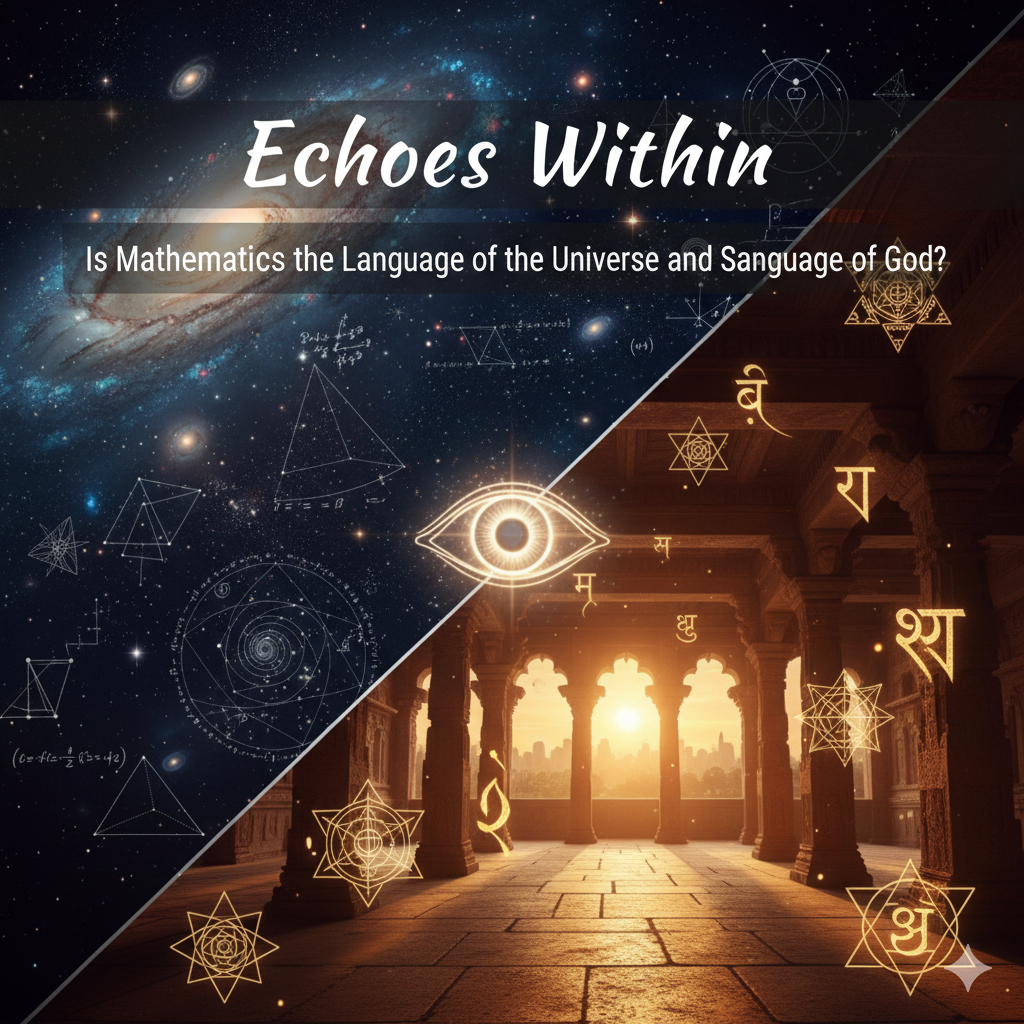
🌌 Introduction: Two Powerful Claims That Shape Human Thought
For centuries, scholars have said mathematics is the language of the universe. At the same time, sages and spiritual traditions have called Sanskrit the language of God.
At first glance, these statements seem to belong to different worlds—one scientific, the other spiritual. However, when examined deeply, both reveal how humans try to understand reality, order, and meaning.
So, are these claims literal truths, metaphors, or something in between?
🔢 Why Mathematics Is Called the Language of the Universe
Firstly, mathematics describes patterns, relationships, and laws that govern the physical world.
For example:
-
Gravity follows mathematical equations
-
Planetary motion obeys geometry
-
Light, sound, and energy behave mathematically
Therefore, mathematics allows the universe to be measured, predicted, and understood.
🧠 Mathematics Is Discovered, Not Invented
Moreover, many scientists argue that mathematics exists independently of humans.
Even if humans disappeared:
-
π would still exist
-
Prime numbers would remain prime
-
Physical constants would not change
Thus, mathematics seems to be embedded in reality itself, not created by culture.
🪐 Mathematics as Universal Truth
Because mathematical laws apply everywhere—from atoms to galaxies—it is called a universal language. Any intelligent being, anywhere in the cosmos, could theoretically understand physics through mathematics.
Hence, mathematics transcends:
-
Culture
-
Language
-
Religion
It is universal by nature.
📜 Why Sanskrit Is Called the Language of God
On the other hand, Sanskrit is called the language of God not because gods “speak” it, but because of its structure, precision, and spiritual role.
Sanskrit:
-
Has highly logical grammar (Panini’s system)
-
Preserves sound accuracy over millennia
-
Is central to Vedic and philosophical texts
Therefore, it is revered as a sacred medium of knowledge.
🔊 Sound, Meaning, and Consciousness
Furthermore, in ancient Indian philosophy, sound (Shabda) is seen as a fundamental force.
Mantras in Sanskrit are believed to:
-
Affect consciousness
-
Carry vibrational significance
-
Preserve precise meaning without distortion
Thus, Sanskrit is viewed as a language of spiritual realization, not casual communication.
🧩 Literal Truth or Symbolic Meaning?
Importantly, neither claim should be taken literally.
-
Mathematics does not “speak”
-
God does not require a human language
Instead:
-
Mathematics symbolizes cosmic order
-
Sanskrit symbolizes spiritual discipline and clarity
Both act as bridges between the human mind and deeper reality.
⚖️ Science and Spirituality: Conflict or Complement?
Rather than conflicting, these two ideas complement each other.
-
Mathematics explains how the universe works
-
Sanskrit-based philosophy asks why existence matters
Together, they address:
-
External reality
-
Inner consciousness
Thus, one governs laws, the other guides values.
🌍 Cultural Context Matters
It is also important to recognize cultural pride without absolutism.
-
Other cultures have sacred languages
-
Other systems also describe the universe
Respecting symbolism prevents misuse of science or religion.
🌱 What This Means for Modern Learners
For students and thinkers today:
-
Mathematics trains logic and precision
-
Sanskrit trains discipline, focus, and philosophical depth
Both develop the mind—in different but complementary ways.
🧘 Conclusion: Two Languages, One Human Quest
In conclusion, mathematics is called the language of the universe because it reveals universal patterns and laws. Sanskrit is called the language of God because it preserves spiritual knowledge with exceptional precision.
Neither claim excludes the other. Instead, they reflect humanity’s timeless quest to understand both the outer cosmos and the inner self.
True wisdom lies not in choosing one—but in understanding both.
📢 Call to Action
If this article sparked deeper thought, share it with someone who loves science, philosophy, or culture. Meaning grows when perspectives meet.