
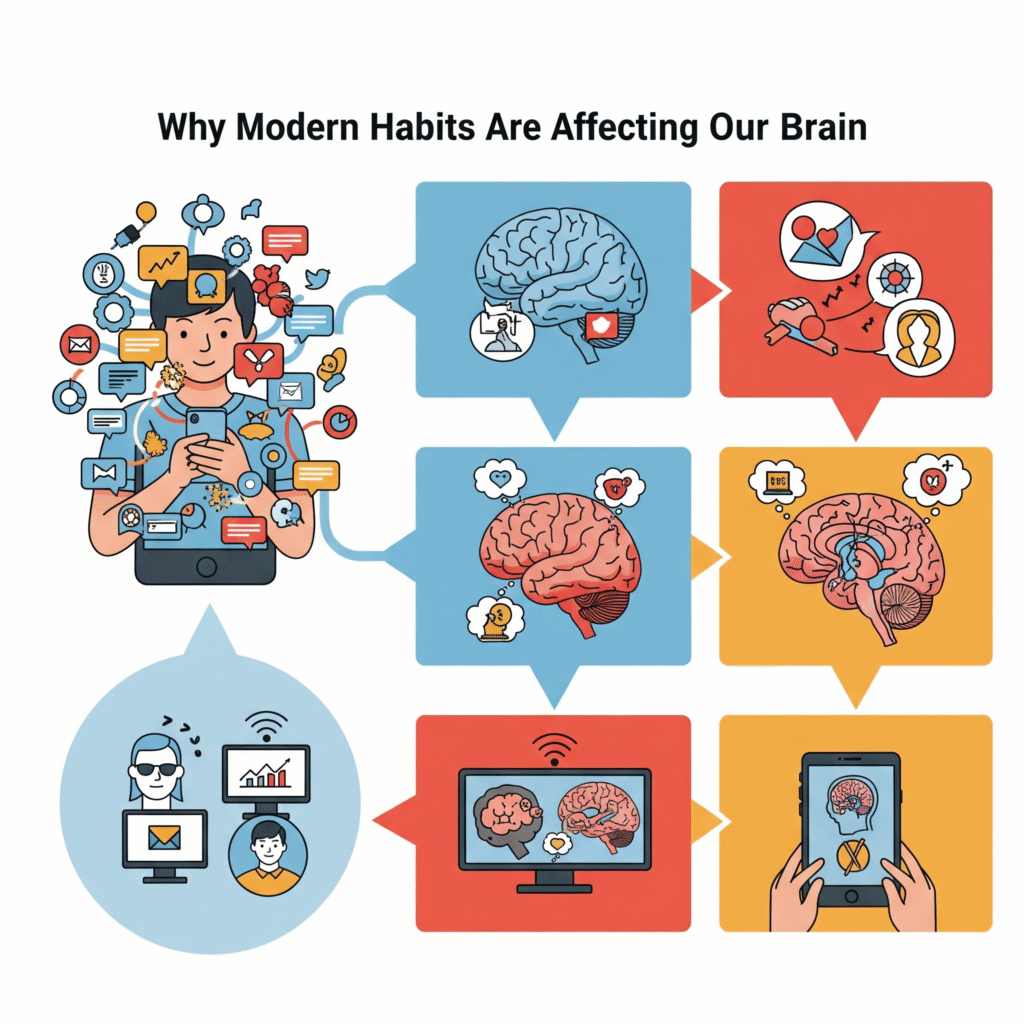
In today’s fast-moving world, the way we think, feel, and act is shifting — and the root of it lies in why modern habits are changing our brains. And the better Answer to it lies in “How?” We scroll endlessly, respond instantly, and rarely sit in silence. But behind these daily actions, our brain is quietly being rewired.
Let’s dive into the neuroscience behind our habits and uncover how the modern world is reshaping our minds, often without us realising it.

The Brain Learns by Repetition — Even Bad Habits
Our brain has an incredible ability called neuroplasticity. This means it adapts and rewires itself based on what we repeatedly do. While this helps us learn, it also means that unhealthy or shallow habits — like doomscrolling, multitasking, and digital dependency — begin to feel “normal” over time.
Every time you check your phone for no reason, skip from one app to another, or avoid thinking deeply, your brain creates shortcuts. Eventually:
You lose focus quickly
You struggle to sit with boredom
Your brain craves quick rewards
Clearly, modern habits are changing our brains, not just our lifestyles.
Dopamine Addiction: Rewiring the Reward System
Most modern habits, especially those involving technology, are designed to trigger dopamine, the “feel-good” brain chemical. Whether it’s getting a like on social media or watching short, entertaining videos, your brain starts chasing these quick dopamine hits.
However, this reward loop has a cost.
Instead of enjoying natural pleasures — like reading a book, walking in nature, or creating something meaningful — we now seek faster, easier stimulation. As a result:
Real-life experiences feel dull
Boredom feels painful
Long-term goals feel too slow
This is how modern habits are changing our brain at a chemical level, reducing our ability to enjoy life deeply.
Multitasking Is Killing Deep Focus
Modern life rewards speed, not depth. We’re constantly encouraged to do multiple things at once — reply to messages while working, watch videos while eating, switch apps every few seconds.
But here’s the truth: the human brain is not built for multitasking.
Instead of handling several tasks efficiently, the brain keeps switching attention back and forth, creating mental fatigue and confusion. Over time:
Focus becomes weaker
Productivity drops
Mental clarity fades
This explains why modern habits are changing our brains, making it harder to concentrate, reflect, and think clearly.
The Loss of Reflection and Imagination
In the past, moments of silence were filled with imagination, reflection, or creativity. Today, silence feels uncomfortable, so we reach for our devices.
But in doing so, we are slowly training our brain to:
Avoid solitude
Fear silence
Depend on constant input
Without these quiet moments, the brain loses its ability to generate original thoughts and process emotions. That’s why many people feel mentally foggy or emotionally numb — their brain no longer knows how to sit still and feel.
Clearly, the way modern habits are changing our brain isn’t just scientific — it’s deeply human.
Are We Outsourcing Our Thinking?
Modern tools are powerful, but they also create dependency. Instead of remembering facts, solving problems, or navigating naturally, we now rely on:
Google for answers
GPS for directions
Apps for decisions
While convenient, this reduces mental effort, which is essential for brain development. If we stop using our mental muscles, they begin to weaken, just like unused physical muscles.
This growing dependence shows how modern habits are changing our brain, not through damage, but through disuse.
How to Reclaim Your Brain in the Modern World
Thankfully, the brain’s flexibility works both ways. Just as negative habits rewire it, positive habits can rebuild it. Here’s how to take control:
Practice deep focus with zero distractions
Replace short-form content with long-form reading
Take tech-free walks and let your mind wander
Train patience by delaying gratification
Embrace boredom and silence regularly
Your brain is your most valuable asset — and with awareness and effort, you can protect it from modern overload.
Final Thoughts
Whether we notice it or not, modern habits are changing our brains, affecting attention, emotion, and thinking. The good news? Change is possible. By becoming conscious of our daily behaviours and choosing more mindful practices, we can rewire our brains toward clarity, focus, and inner peace.
Let your brain work for you, not for the algorithms.
To understand how these habits are not just reshaping our brains but also our entire way of being, check out my in-depth analysis on how modern habits are changing human nature.
Suggested Outbound References:
Neuroplasticity and Habit Formation
Source: Harvard Medical School – Neuroplasticity
→ Use this link when mentioning: “The brain rewires through repetition.”Dopamine and the Reward System
Source: Verywell Mind – How Dopamine Affects the Brain
→ Use when discussing: “Modern habits trigger quick dopamine hits.”Multitasking and Brain Damage
Source: NPR – Think You’re Multitasking? Think Again
→ Use when saying: “The brain can’t handle multitasking well.”
Pingback: Digital Detox: Why Your Brain Needs a Break from Screens
Thanks for sharing. I read many of your blog posts, cool, your blog is very good.
Thank you for your sharing. I am worried that I lack creative ideas. It is your article that makes me full of hope. Thank you. But, I have a question, can you help me? https://accounts.binance.info/register-person?ref=IXBIAFVY
Your article helped me a lot, is there any more related content? Thanks!
Thanks for sharing. I read many of your blog posts, cool, your blog is very good. https://accounts.binance.info/si-LK/register?ref=LBF8F65G
Your article helped me a lot, is there any more related content? Thanks!