
Class - 10 (Science and Technology)
1. Definition and Terms Related to Lenses
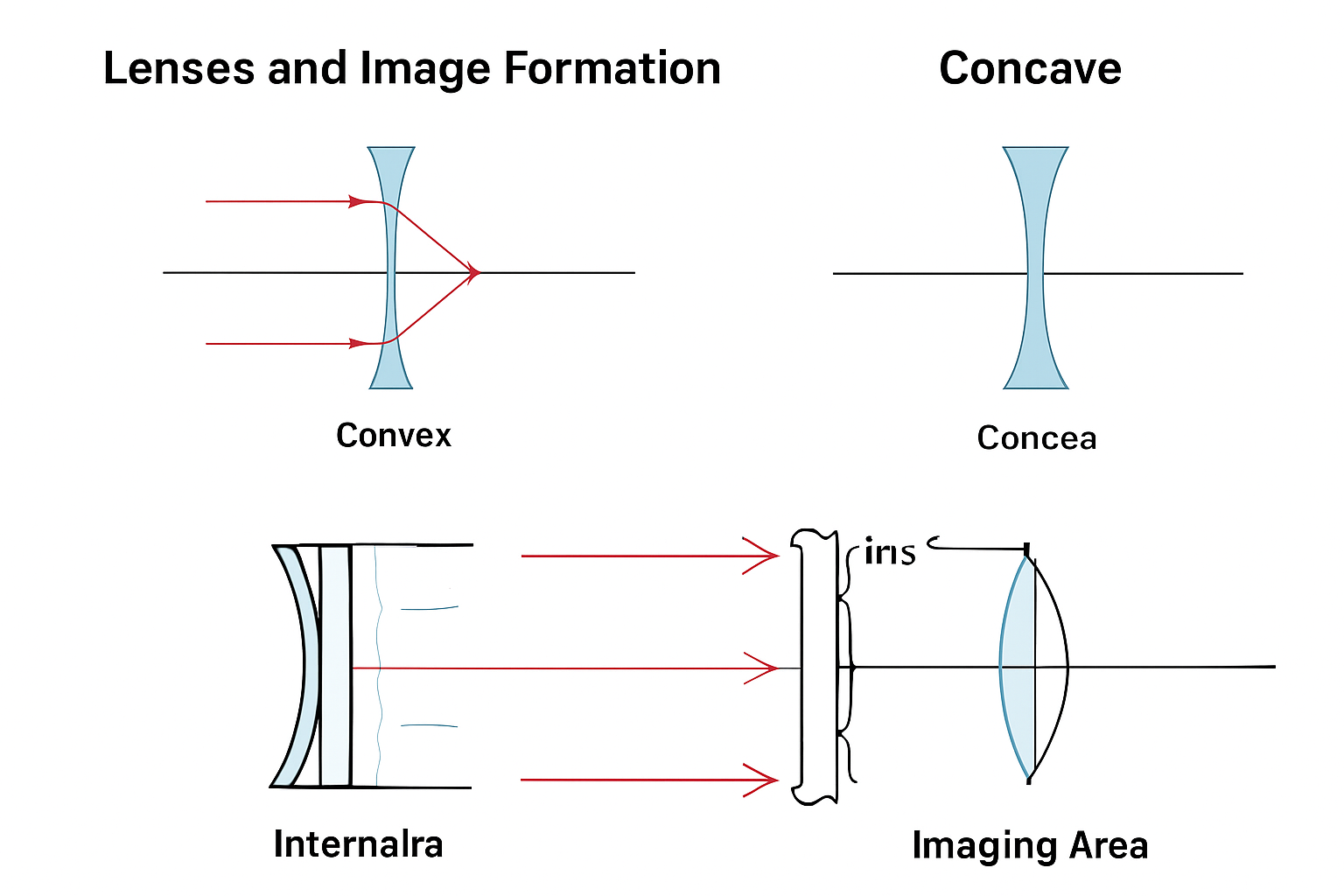
A lens is a transparent piece of glass or plastic with curved surfaces that refract light rays to form an image. Lenses are mainly of two types:
Convex lens (Converging lens): Thicker in the middle and thinner at the edges; it converges light rays to a point.
Concave lens (Diverging lens): Thinner in the middle and thicker at the edges; it diverges light rays outward.
Key Terms:
Principal Axis: The straight line passing through the center of the lens and both its surfaces.
Optical Center (O): The midpoint of the lens through which a ray of light passes undeviated.
Principal Focus (F): The point on the principal axis where parallel rays either converge (in convex lens) or appear to diverge (in concave lens) after refraction.
Focal Length (f): The distance between the optical center and the principal focus.
2. Laws of Refraction in a Lens
Light passing through a lens follows the laws of refraction:
The incident ray, refracted ray, and normal all lie in the same plane.
The ratio of the sine of the angle of incidence to the sine of the angle of refraction is constant (Snell’s Law).
Illustration:
When a ray of light enters a convex lens obliquely, it bends toward the normal at the first surface and away from the normal at the second surface, finally converging to form an image on the opposite side.
3. Image Formation by Lenses
The image formed by a lens depends on the position of the object relative to the lens.
For a convex lens:
When the object is far away, a real, inverted, and small image is formed near the focus.
When the object is between F and 2F, a real, inverted, and magnified image is formed beyond 2F.
When the object is between F and O, a virtual, erect, and magnified image is formed on the same side as the object.
For a concave lens:
The image is always virtual, erect, and smaller than the object, irrespective of the object’s position.
4. Optical Power of a Lens
The optical power (P) of a lens indicates how strongly it converges or diverges light.
It is defined as the reciprocal of the focal length (f in meters):
P=1/f
Unit: Diopter (D)
For convex lenses, the power is positive.
For concave lenses, the power is negative.
Relationship Between Curvature and Power:
A lens with more curved surfaces has a shorter focal length and therefore greater power.
5. Practical Applications
Convex lenses are used in magnifying glasses, cameras, microscopes, and projectors.
Concave lenses are used in spectacles for short-sighted people and laser beam expanders.
Finish Course Early?
You have not completed all required lessons and assessments.