
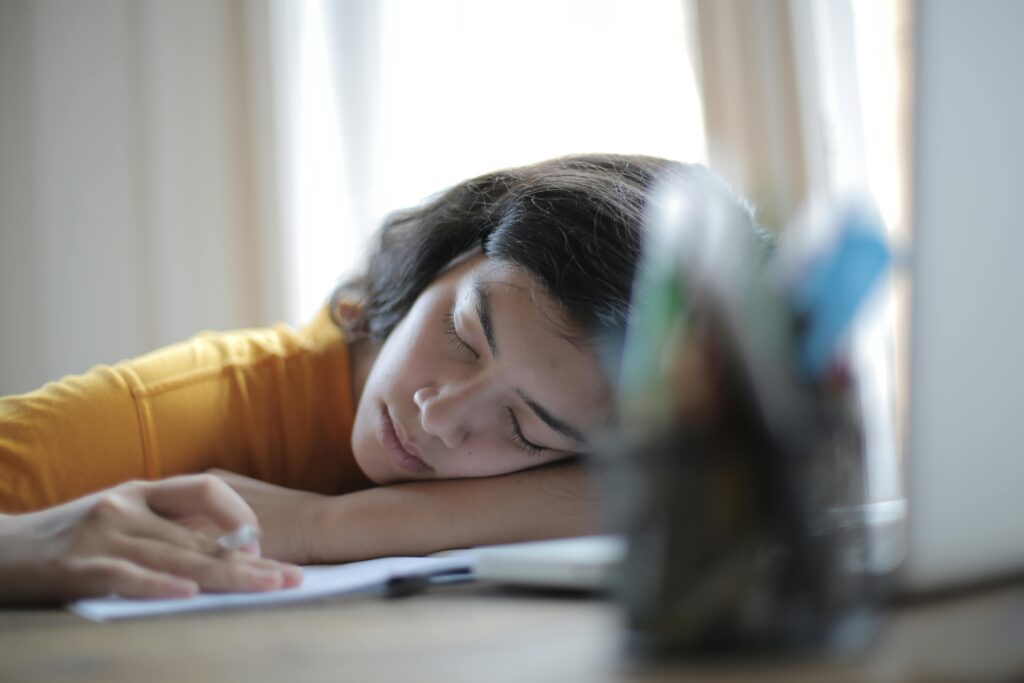
🪑 Introduction: When the Chair Becomes a Bed
(sleepy at work neuroscience)
Have you ever experienced this strange moment—
You are sitting upright on a working chair, surrounded by tasks, yet your eyes slowly close and your head nods forward?
Surprisingly, this is not laziness.
Instead, it is a biological signal from your brain.
So, what exactly is happening inside your nervous system?
🧠 The Brain Is Not Designed for Continuous Alertness
First of all, the human brain works in cycles, not nonstop focus.
Even during daytime:
Attention naturally fluctuates
Alertness rises and falls
Energy dips occur every 90–120 minutes
Therefore, when prolonged mental work continues without breaks, the brain forces a pause—sometimes through sleepiness.
⏰ The Post-Lunch Dip: A Biological Reality
Interestingly, many people feel sleepy between 1 PM and 3 PM, even without eating heavily.
This happens because:
The brain’s alertness rhythm naturally drops
Body temperature slightly decreases
Melatonin (sleep-related hormone) briefly increases
As a result, your brain begins shifting toward rest mode, even while sitting upright.
🧩 Why a Working Chair Triggers Sleep
Now comes the surprising part.
A working chair:
Restricts movement
Reduces sensory stimulation
Keeps the body passive
Meanwhile, the brain interprets this stillness as:
“No immediate survival task detected.”
Consequently, the arousal system in the brain reduces activity, allowing sleep pressure to rise.
🧠 Mental Fatigue vs Physical Fatigue
Moreover, chair-sleepiness is mostly caused by mental fatigue, not physical tiredness.
Mental fatigue happens when:
The same cognitive task repeats
Decision-making is continuous
Information overload occurs
Neuroscience studies from institutions like Harvard Medical School show that prolonged cognitive load reduces activity in attention networks—making sleep more likely, even without physical exhaustion.
🔌 Glucose, Oxygen, and the Brain
Additionally, the brain depends heavily on:
Glucose
Oxygen
Blood flow
When you sit too long:
Blood circulation slows
Oxygen delivery reduces slightly
Brain energy efficiency drops
As a result, drowsiness emerges as a protective shutdown signal.
😴 Micro-Sleeps: The Brain’s Emergency Brake
Sometimes, you are not truly sleeping—but experiencing micro-sleeps.
These are:
1–10 second lapses in awareness
Automatic brain responses
Common during monotony
Even if your eyes stay open, the brain briefly “goes offline”.
⚠️ Why Fighting Chair-Sleep Is Counterproductive
Many people force themselves awake using:
Excessive caffeine
Self-blame
Stress
However, neuroscience shows this increases:
Cortisol (stress hormone)
Mental burnout
Long-term productivity loss
In short, ignoring brain signals worsens performance.
✅ What Science Suggests Instead
Rather than fighting sleepiness, try this:
✔ Stand up every 45–60 minutes
✔ Expose yourself to natural light
✔ Stretch or walk for 2–5 minutes
✔ Hydrate before caffeine
✔ Take a short 10–20 minute power nap if possible
These methods reset neural alertness naturally.
🌍 Modern Work Culture vs Human Biology
Finally, the real problem lies in modern work systems:
Long sitting hours
Screen overload
Lack of movement
The brain, however, evolved for movement-based alertness, not chair-bound endurance.
🧠 Final Thought: Your Brain Is Protecting You
So, the next time you fall asleep on a working chair, remember:
Your brain is not failing you—
it is protecting itself.
Listening to these signals can actually make you more productive, healthier, and mentally sharper.
💭 Reflection Question
Are you tired because you are lazy—
or because your brain has been working too hard without rest?
🔍 You Can Also Read:
- Why Staying Alone Silently Is Sometimes Better Than Being with Selfish or Clever People
- Have You Ever Felt Emotionally Disturbed and Unable to Focus on Daily Activities? You’re Not Alone
- Does the Human Appendix Prove That Humans Should Be Vegetarian? A Scientific Perspective
- The Real Reason Behind the Decline of Your Willpower as You Grow Older