
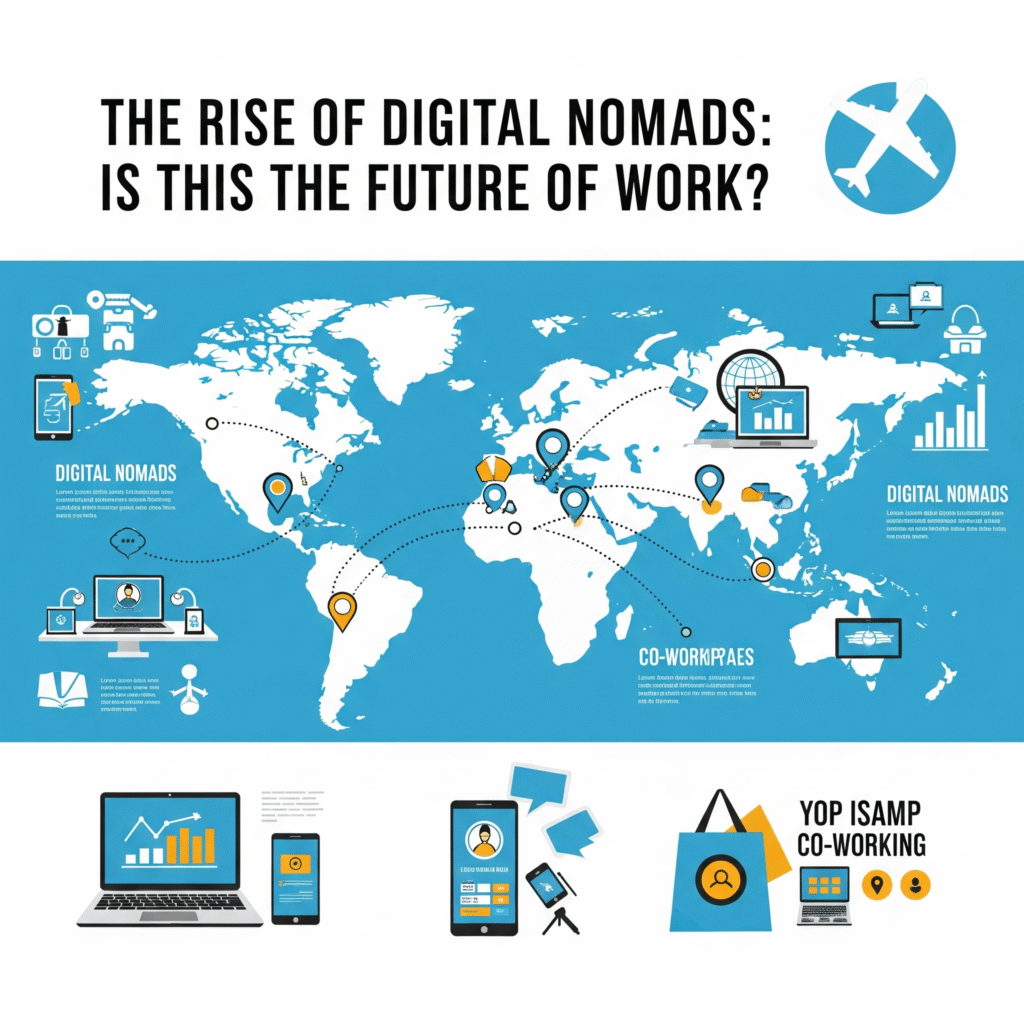
Digital Nomads:
Not long ago, the idea of working from a beach in Bali or a café in Lisbon sounded like a fantasy. Today, it’s a growing reality. Thanks to high-speed internet, cloud-based tools, and shifting work cultures, digital nomadism is no longer a fringe lifestyle—it’s a movement.
But what’s fueling this trend, and more importantly, does it represent the future of work?
Let’s explore how the rise of digital nomads is transforming careers, cultures, and the way we define “the office.”
Who Are Digital Nomads?
Digital nomads are people who work remotely while travelling. Instead of commuting to a traditional office, they rely on laptops and Wi-Fi to work from anywhere in the world. Some stay in one place for months, while others hop from country to country every few weeks.
This lifestyle isn’t limited to freelancers or influencers. Increasingly, even full-time employees are embracing location-independent work, with employers supporting remote-first or hybrid models.
Why Is the Digital Nomad Trend Growing?
Several key factors have fueled this global shift:
1. Remote Work Became the Norm
The COVID-19 pandemic accelerated remote work on an unprecedented scale. What began as a temporary solution became a long-term strategy for many companies. Once workers got a taste of location freedom, returning to the office lost its appeal.
2. Technology Made It Possible
Tools like Zoom, Slack, Notion, and cloud storage made collaboration seamless—even across continents. As tech advanced, the barriers to remote work disappeared.
3. Work-Life Balance Took Priority
More people are redefining success—not by promotions or paychecks alone, but by quality of life and freedom. The digital nomad lifestyle offers a blend of career and adventure that traditional jobs rarely provide.
4. Countries Welcomed Remote Workers
Governments caught on. Nations like Portugal, Costa Rica, and Estonia now offer digital nomad visas, inviting remote workers to live and contribute to local economies.
How Is This Changing Work Culture?
The rise of digital nomads signals deeper changes in how we view work:
Work is no longer a place—it’s an activity. Productivity is measured by output, not presence.
Flexibility becomes a top priority. Employees now seek jobs that offer location and time autonomy.
Global teams become the norm. Companies hire talent from anywhere, broadening their reach and diversity.
This cultural shift encourages innovation, but also requires trust, self-discipline, and clear communication.
Challenges of the Digital Nomad Lifestyle
Of course, it’s not all sunsets and smoothies. Here are a few downsides:
Loneliness and disconnection – Constant travel can make it difficult to form lasting relationships.
Visa and tax complexities – Navigating legal requirements in different countries can be tricky.
Burnout risk – Without structure, some nomads work more, not less.
Despite these challenges, many feel the freedom outweighs the friction.
Is This the Future of Work?
All signs point to yes, with balance. While not everyone wants to live on the road, the values behind the digital nomad trend—freedom, flexibility, and autonomy—are here to stay.
Companies that adapt to this mindset will attract top talent, and employees who master self-management and communication will thrive. And the line between work and life? It will continue to blur—in ways both exciting and complex.
Final Thoughts
The rise of digital nomads represents more than a trend; it’s a reflection of a changing global workforce. As technology empowers us to work from anywhere, we must rethink what we want from our careers—and how work fits into our lives.
In the end, the future of work might not be tied to a location, but to a lifestyle that values freedom, purpose, and global connection.
🔗 Further Reading & Trusted Sources:
The Psychology of Procrastination: Why We Self-Sabotage
Digital Detox: Why Your Brain Needs a Break from Screens
5 Psychology-Based Habits to Boost Focus in a Digital World
Rewire Your Brain for Focus: 3-Minute Daily Practices That Really Work
Harvard Business Review – You’re Not Paranoid: Your Phone Really Is Listening to You
Can you be more specific about the content of your article? After reading it, I still have some doubts. Hope you can help me. https://accounts.binance.info/sl/register?ref=I3OM7SCZ