
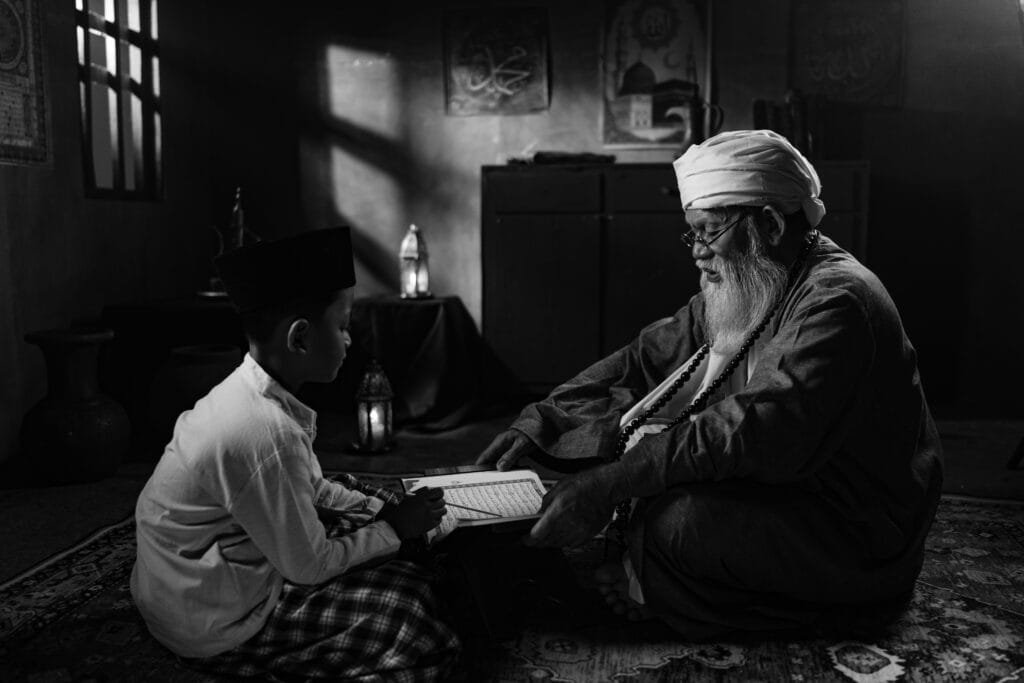
(Is a guru necessary for enlightenment)
A well-known saying in the Hindu tradition is:
“Without a Guru, knowledge has no true meaning.”
In this article, the word “Guru” is used in its traditional Hindu sense, referring to a spiritual teacher or guide, not as a generic term for an expert.
For centuries, this idea has guided students, seekers, and spiritual practitioners. But in today’s world, where knowledge is available through books, universities, and the internet, an important question arises:
Is a Guru still necessary?

Or can we become enlightened through self-learning alone?
What Is the Difference Between Information and Wisdom?
Today, information is everywhere.
With a mobile phone, we can learn almost anything. We can watch lectures, read books, and even ask artificial intelligence to explain difficult ideas.
But information is not the same as wisdom.
Information fills the mind.
Wisdom transforms the person.
A mentor or guru often helps us apply knowledge in real life, recognize our blind spots, and avoid repeating mistakes.
Who Can Be a Guru?
Many people imagine a guru as a spiritual master living in a temple or monastery.
But perhaps the word “guru” has a broader meaning.
A guru may be:
- A school teacher.
- A parent.
- A mentor at work.
- A friend who tells us an uncomfortable truth.
- A book that changes our thinking.
- Even a difficult life experience.
Sometimes life itself becomes the greatest teacher.
The important question is not, “Who is my guru?”
It is, “Am I willing to learn?”
A Lesson from Psychology
Psychology also supports the idea that our reactions are often shaped by how we interpret events.
Imagine a tree trunk lying across a forest path.
A bear walking peacefully suddenly finds its path blocked.
The tree did not create anger.
The tree simply became a trigger.
The bear’s reaction arose because its goal was interrupted.
Similarly, in daily life, traffic, criticism, or failure do not automatically create anger.
They become triggers, while our own mind determines the response.
This idea reminds us that learning is not only about gaining knowledge. It is also about understanding ourselves.
Why Do We Need Guidance?
Every expert once had a guide.
Athletes have coaches.
Scientists have supervisors.
Musicians have teachers.
Even great spiritual leaders often learned from someone before becoming teachers themselves.
A good mentor does not think for us.
Instead, they help us think more clearly.
They ask difficult questions.
They point out mistakes that we cannot see ourselves.
They encourage growth while keeping us humble.
Can We Learn Without a Guru?
Yes, we can learn many things independently.
And moreover,
Self-study builds discipline and curiosity.
However, there are moments when an experienced guide helps us move forward faster by correcting errors that we might not notice.
Perhaps the real purpose of a guru is not to give us knowledge.
But,
It is to help us discover truth for ourselves.

Final Reflection
Whether your guide is a spiritual teacher, a mentor, a parent, a book, or life’s own experiences, wisdom grows when we remain open to learning.
Knowledge may begin with reading.
But understanding grows through reflection, practice, and guidance.
The true guru does not create wisdom inside us.
The true guru helps uncover the wisdom that was waiting within us all along.
You Can Also Read:
- Life Is Not About Waiting for Difficulties to Pass, but About Learning to Live, Grow, and Find Joy
- 🌞 How to Increase Your Consciousness Level Without Any mastermind or mentor
- Is Meditation Just for Lazy People? Or Is There a Hidden Science Behind It?
- Signs You’re in a Toxic Relationship: 15 Red Flags You Should Never Ignore