
Why is the West more developed than the East?


For thousands of years, many people have believed that the East has been the birthplace of profound spiritual traditions. Ancient scriptures, philosophies, meditation practices, and teachings about compassion, self-discipline, and inner peace emerged from regions such as India, Nepal, China, and other parts of Asia. Many followers of these traditions also believe that divine incarnations, enlightened teachers, and great sages appeared in the East to guide humanity.
Yet a question often arises:
If the East possessed such deep spiritual wisdom, why did many Western nations become more economically, scientifically, and technologically developed?
The answer is more complex than it first appears.
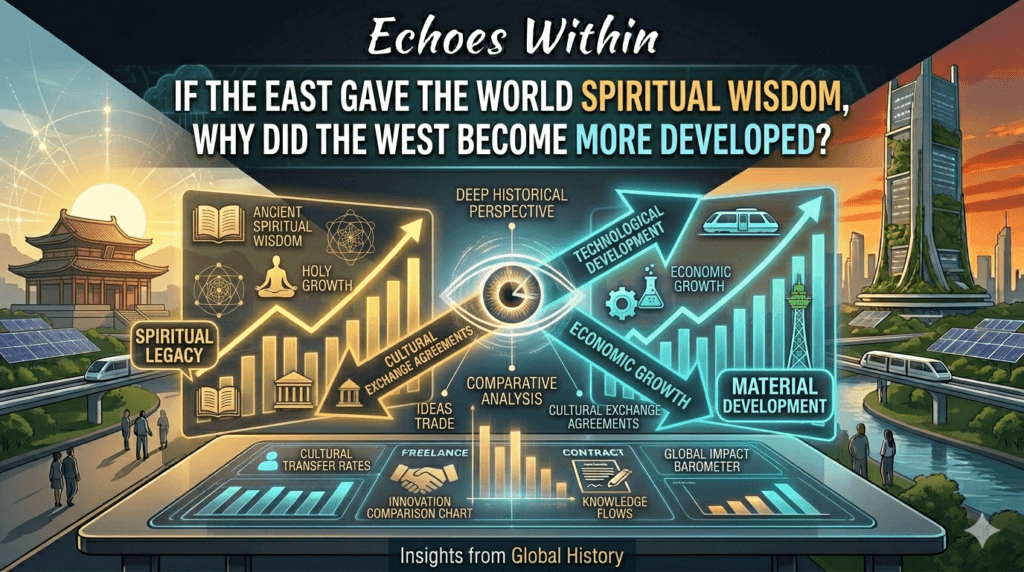
Two Different Meanings of “Development”
Before comparing civilizations, it is important to understand that development has more than one meaning.
One kind is material development, including:
- Strong economies
- Advanced technology
- Modern healthcare
- Scientific discoveries
- High industrial productivity
Another kind is spiritual development, including:
- Inner peace
- Self-control
- Compassion
- Ethical living
- Search for life’s meaning
History shows that these two forms of development do not always progress together.
Why Many Spiritual Traditions Emerged in the East
Many Eastern civilizations encouraged people to ask fundamental questions:
- Who am I?
- What is the purpose of life?
- Why do suffering and death exist?
- How can lasting happiness be found?
Instead of focusing only on external success, many traditions emphasized inner transformation. As a result, generations of philosophers, saints, monks, and scholars developed teachings on meditation, ethics, and self-realization.
These ideas continue to influence millions of people around the world today.
Why Many Western Nations Advanced Faster Economically
Meanwhile, several historical developments helped many Western countries accelerate material progress.
1. Scientific Revolution
European scholars increasingly relied on observation, experimentation, and mathematical reasoning. This approach led to rapid scientific discoveries.
2. Industrial Revolution
Machines transformed manufacturing, transportation, and agriculture. Consequently, productivity and wealth grew dramatically.
3. Strong Institutions
Many countries gradually developed systems that protected property rights, encouraged entrepreneurship, and invested in public education.
4. Global Trade
Maritime exploration and international commerce expanded access to resources, markets, and new ideas.
5. Investment in Research
Governments, universities, and private industries invested heavily in science, engineering, and innovation.
Together, these factors created long-term economic growth.
Did Spirituality Slow the East?
Some people argue that excessive focus on renunciation or the afterlife reduced attention to industry and innovation. However, this explanation is too simplistic.
In reality, many Eastern societies also made remarkable contributions to mathematics, astronomy, medicine, metallurgy, architecture, and philosophy.
Historical events such as invasions, colonial rule, political instability, internal conflicts, and unequal access to industrial technologies also shaped economic outcomes. Therefore, differences in development cannot be explained by spirituality alone.
What Can the East Learn from the West?

The East can continue to strengthen:
- Scientific research
- Innovation
- Entrepreneurship
- Quality education
- Transparent governance
- Efficient public institutions
These areas support economic growth while remaining compatible with cultural and spiritual values.
What Can the West Learn from the East?
At the same time, many people in Western societies increasingly explore Eastern traditions for guidance on:
- Mindfulness
- Meditation
- Stress management
- Compassion
- Work-life balance
- Meaning and purpose
This growing interest suggests that material success alone does not satisfy every human need.

The Best Future May Combine Both
Perhaps the most promising path is not choosing one civilization over another but learning from both.
Imagine a society that combines:
- Western scientific innovation,
- Eastern ethical wisdom,
- Modern education,
- Compassionate leadership,
- Economic opportunity,
- Environmental responsibility, and
- Inner well-being.
Such a balance could benefit individuals and societies alike.
Final Thoughts
The comparison between East and West should not be viewed as a competition. Instead, it is an opportunity to understand how different civilizations have contributed to humanity in unique ways.
The East has profoundly influenced the world’s spiritual and philosophical heritage, while many Western nations have driven advances in science, technology, and industrial development. Both legacies have enriched human civilization.
Ultimately, lasting progress may come from integrating wisdom with knowledge, ethics with innovation, and inner growth with material advancement. A truly developed society is one that not only creates wealth but also nurtures justice, compassion, curiosity, and human dignity.