
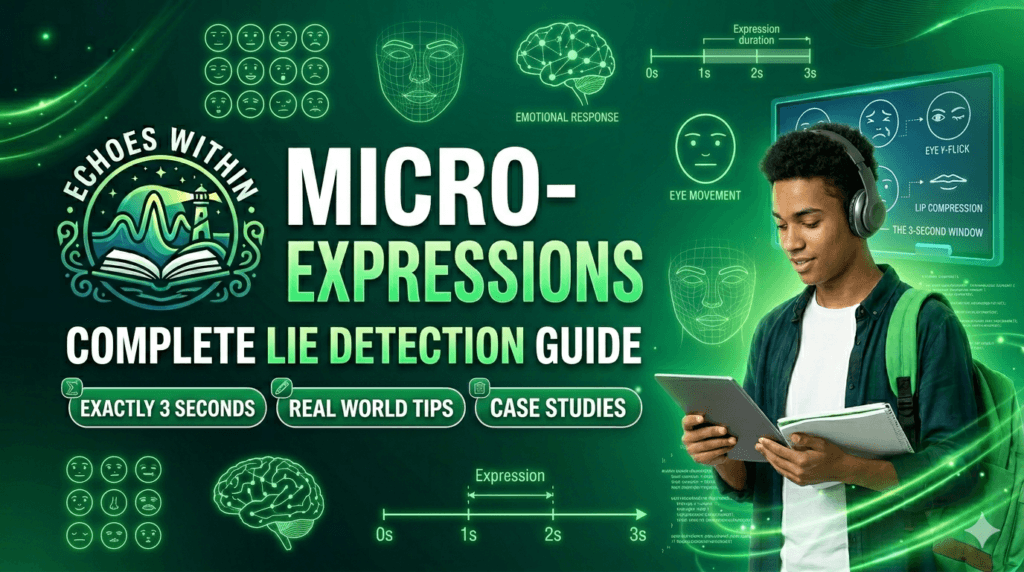
How to spot a liar in 3 seconds:
Have you ever felt that something was “off” during a conversation, even though the person’s words sounded perfectly believable? Surprisingly, your brain may have detected tiny facial movements that appeared for only a fraction of a second. These brief and involuntary reactions are known as micro-expressions, and many psychologists consider them one of the most revealing windows into human emotions.
While no method can guarantee that someone is lying, micro-expressions can provide valuable clues. Therefore, learning to recognize them may help you better understand people in interviews, business negotiations, friendships, and everyday interactions.

What Are Micro-Expressions?
Micro-expressions are extremely brief facial expressions that appear for less than half a second. Unlike regular expressions, they are often unconscious and difficult to control.
In other words, a person may smile with their mouth while their face briefly reveals fear, anger, guilt, or anxiety. Consequently, these hidden emotional leaks can sometimes contradict what they are saying.
Researchers studying human behavior have found that emotions often appear on the face before people can consciously suppress them. As a result, micro-expressions have become an important topic in psychology, law enforcement, and behavioral science.
The “3-Second Rule” of Lie Detection
When people hear “spot a liar in 3 seconds,” they often imagine a magical trick. However, the reality is more practical.
The first three seconds of a response are often the most revealing because:
- Natural emotions appear before conscious control takes over.
- Facial reactions happen faster than spoken words.
- Stress-related signals are often strongest immediately after a difficult question.
- Hidden emotions may briefly surface before being masked.
Therefore, paying close attention during those first few seconds can reveal important inconsistencies.
7 Micro-Expressions That May Reveal Deception
1. The Flash of Fear
Fear frequently appears when someone worries about being exposed.
Watch for:
- Raised eyebrows
- Wide-open eyes
- Tension around the mouth
If a person’s face briefly shows fear immediately after a simple question, it may indicate discomfort or anxiety.
2. Sudden Lip Compression
Many people press their lips together when withholding information.
This expression may suggest:
- Internal conflict
- Reluctance to speak
- Emotional restraint
Although it does not automatically indicate lying, it often signals that something remains unsaid.
3. Brief Contempt
Contempt is one of the easiest micro-expressions to recognize.
Signs include:
- One corner of the mouth raised slightly
- A quick smirk
- Subtle facial asymmetry
Interestingly, contempt can appear when a person feels superior or believes they are successfully deceiving others.
4. Rapid Eye Changes
Contrary to popular belief, liars do not always avoid eye contact.
Instead, you may notice:
- Unusually intense staring
- Rapid blinking
- Sudden changes in eye behavior
Therefore, it is better to look for changes from a person’s normal behavior rather than relying on stereotypes.
5. Forced Smiles
A genuine smile activates muscles around both the mouth and the eyes.
A forced smile often:
- Appears too quickly
- Disappears abruptly
- Lacks eye involvement
Consequently, a mismatch between the smile and the surrounding facial muscles can be revealing.
6. Jaw Tension
When people experience stress, the jaw often tightens automatically.
Watch for:
- Clenched teeth
- Tight jaw muscles
- Brief facial rigidity
Because deception can create psychological pressure, jaw tension frequently accompanies uncomfortable situations.
7. Inconsistent Emotional Timing
Perhaps the strongest clue is emotional inconsistency.
For example:
- The smile comes after the statement rather than during it.
- Surprise appears too late.
- Sadness looks delayed or exaggerated.
When emotions and words fail to align naturally, it may suggest that the expression is being consciously managed.
Why Micro-Expressions Matter
Micro-expressions matter because emotions are often faster than conscious thought.
While people can carefully choose their words, controlling every facial muscle is significantly more difficult. Therefore, tiny emotional leaks may reveal stress, discomfort, uncertainty, or hidden feelings.
However, these expressions should never be used as definitive proof of lying.
Important Warning: Micro-Expressions Are Not Lie Detectors
This is where many people make mistakes.
A micro-expression does not automatically mean someone is lying.
Fear, anxiety, nervousness, embarrassment, and stress can all produce similar reactions. For instance, an innocent person being falsely accused may display many of the same signs as a guilty individual.
Therefore, professionals focus on clusters of behaviors rather than a single signal.
The most reliable approach is to look for:
- Multiple indicators occurring together
- Changes from normal behavior
- Context of the conversation
- Consistency between words and emotions
How to Improve Your Observation Skills

If you want to become better at reading people, start by observing everyday conversations.
Pay attention to:
- Timing of facial expressions
- Eye behavior
- Changes in voice tone
- Body language shifts
- Emotional consistency
Furthermore, avoid jumping to conclusions. Observation should increase understanding, not encourage unfair judgment.
Final Thoughts
Micro-expressions are fascinating because they reveal how closely emotions and behavior are connected. Although they cannot provide absolute proof that someone is lying, they can offer valuable clues about what a person may be feeling beneath the surface.
The next time you ask an important question, watch carefully during those first three seconds. You may notice a fleeting expression that words alone would never reveal. Nevertheless, remember that the goal is not to become a human lie detector. Instead, it is to become a more attentive observer of human nature.
After all, understanding people often begins with noticing the signals they never intended to send.
Highly Recommended For You:
- Why Do Some People Lie All the Time? How to Protect Yourself from Constant Liars
- Why Do We Feel Happy When Others Praise Us? The Psychology Behind Validation and Happiness
- The Future of Medical Body Modification: How Smart Implants and Bio-Tech Could Transform Healthcare
- 7 Body Mods That Are Actually Useful (And 3 That Are Purely Viral Trends)