📘 Summary Note – Work, Energy & Power (For MCQ Practice)
Here is a clear and concise summary note of the lesson Work, Energy, and Power, specifically designed to help you understand key concepts and prepare effectively for MCQs:
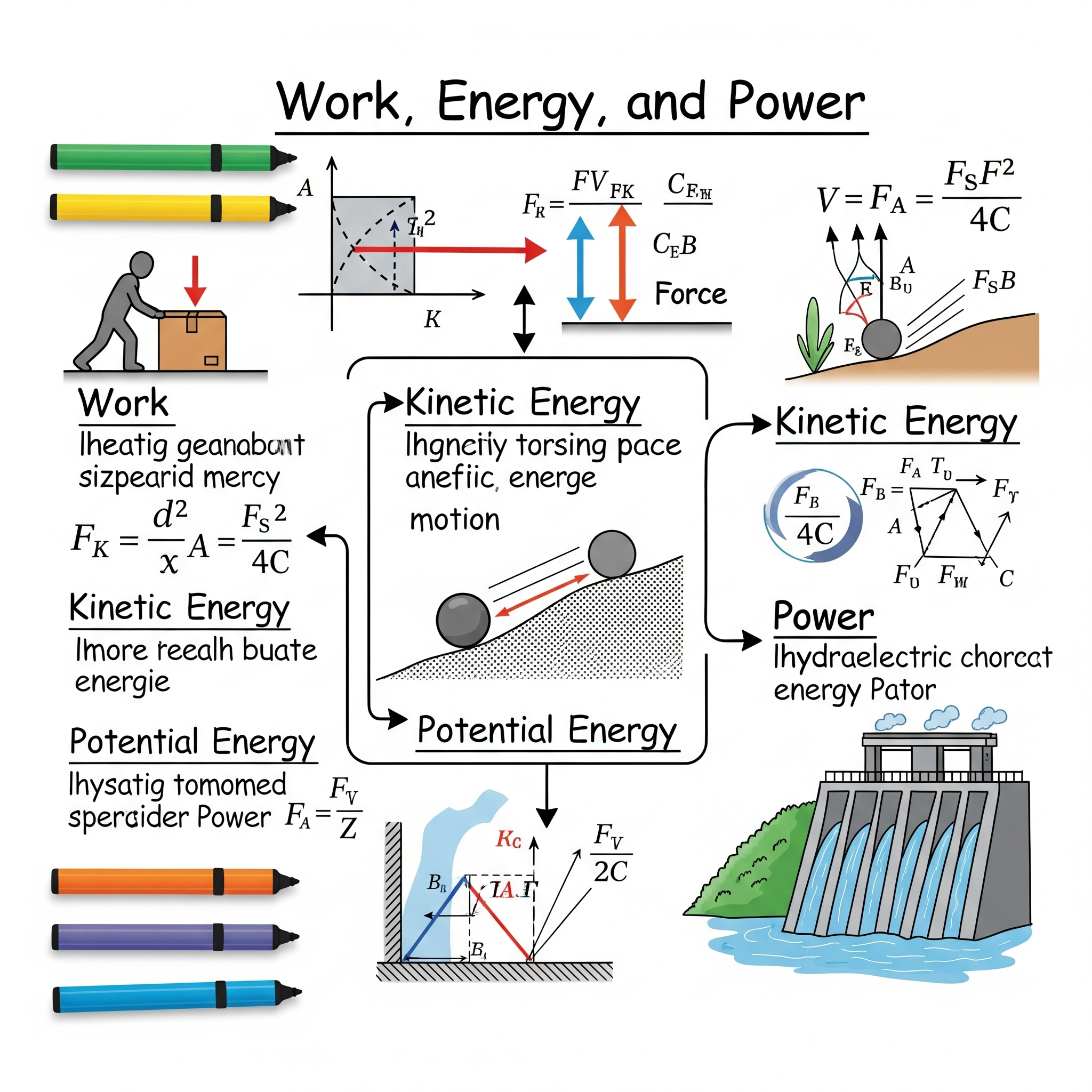
🔹 1. Work
Work is said to be done when a force is applied and there is displacement in the direction of the force.
Formula:
W = F × d × cosθ
where:W = Work done
F = Force applied
d = Displacement
θ = Angle between force and displacement
Positive work: Force and displacement in the same direction (θ = 0°)
Negative work: Force and displacement in opposite directions (θ = 180°)
Zero work: No displacement or force is perpendicular to displacement (θ = 90°)
SI Unit: Joule (J)
1 Joule = 1 Newton × 1 metre
1 kJ = 1000 J
🔹 2. Energy
Energy is the capacity to do work.
SI Unit: Joule (J)
🟢 Types of Mechanical Energy:
Kinetic Energy (K.E.) – energy of a body due to motion
K.E. = ½ mv²Potential Energy (P.E.) – energy of a body due to position
P.E. = mgh
🔹 3. Work-Energy Theorem
Work done on an object = Change in its kinetic energy
W = ΔK.E.
🔹 4. Power
Power is the rate of doing work.
P = W / t
where:P = Power
W = Work done
t = Time taken
SI Unit: Watt (W)
1 Watt = 1 Joule / 1 second
1 kW = 1000 W
1 HP (Horse Power) = 746 W
🔹 5. Commercial Unit of Energy
1 kilowatt-hour (kWh) = 1000 Watts × 3600 seconds = 3.6 × 10⁶ Joules
It is used for electricity bills.
🔹 6. Law of Conservation of Energy
Energy can neither be created nor destroyed; it only changes from one form to another.
Total energy remains constant in an isolated system.
🧠 MCQ Focus Areas
Definitions and SI units of work, energy, and power
Conditions for positive, negative, or zero work
Formulas of K.E., P.E., Power, Work
Work-Energy theorem
Unit conversions: Joule ↔ kJ, Watt ↔ kW, kWh ↔ J
Application-based and conceptual MCQs: e.g., what happens to K.E. when velocity doubles?
🔍 You Can Also Read:
🧠 Conceptual MCQs – Work, Energy & Power
🔢 Numerical-Based MCQs – Work, Energy & Power
✅ MCQ Quiz – Chapter: Sources of Energy
🧠 Conceptual MCQs – Sources of Energy
🔢 Numerical-Based MCQ – Simple Machine