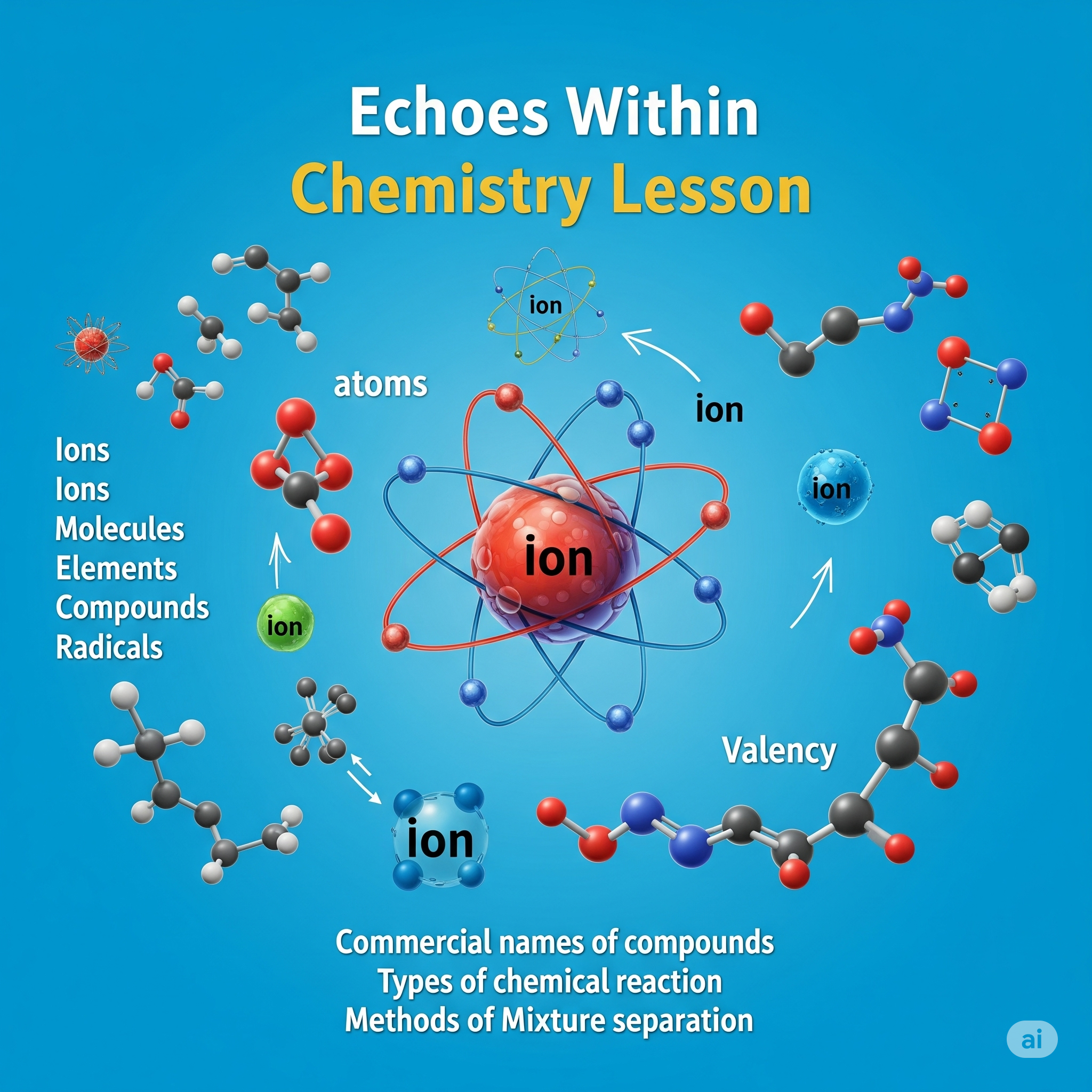
Here is a summary note for MCQ preparation for the lesson:
“General and Language of Chemistry”
(Covers: Atoms, Ions, Molecules, Elements, Compounds, Radicals, Valency, Commercial names of compounds, Types of Chemical Reaction, Methods of Mixture Separation)
1. Atom, Molecule, Ion
Atom: The smallest unit of an element that retains its properties. Eg: H, O, Na.
Molecule: A Combination of two or more atoms (same or different). Eg: O₂, H₂O.
Ion: Charged particles.
Cation: Positively charged (Na⁺, Ca²⁺)
Anion: Negatively charged (Cl⁻, SO₄²⁻)
2. Element and Compound
Element: Pure substance made of only one type of atom. Eg: Iron (Fe), Oxygen (O₂).
Compound: Substance formed by the chemical combination of two or more elements in a fixed proportion. Eg: H₂O, NaCl.
Molecule of Element: O₂, H₂
Molecule of Compound: CO₂, NH₃
3. Radical and Valency
Radical: A Group of atoms that behaves like a single atom in chemical reactions. Can be positive or negative.
Eg: OH⁻, SO₄²⁻, NH₄⁺
Valency: The Combining capacity of an atom or radical.
Eg: H (1), O (2), N (3), C (4), SO₄ (2), Cl (1)
4. Naming Compounds (Commercial Names)
H₂O – Water
NaCl – Table salt
CaCO₃ – Limestone/Marble/Chalk
NaHCO₃ – Baking soda
Ca(OH)₂ – Lime water
Na₂CO₃ – Washing soda
HCl – Hydrochloric acid (muriatic acid)
5. Types of Chemical Reactions
Combination Reaction: A + B → AB
Decomposition Reaction: AB → A + B
Displacement Reaction: A + BC → AC + B
Double Displacement Reaction: AB + CD → AD + CB
Neutralization: Acid + Base → Salt + Water
Combustion: Fuel + O₂ → CO₂ + H₂O + Heat
6. Methods of Separation of Mixtures
Evaporation: For salt from saltwater
Filtration: Insoluble solids from liquids
Distillation: Separating two miscible liquids
Decantation: Solid-liquid separation after sedimentation
Centrifugation: Fine solid particles from liquid
Sublimation: Separating a solid that sublimes (e.g., camphor, iodine)
Chromatography: Separation of different dyes/pigments
Magnetic Separation: Iron from a mixture
🧠 Tips for MCQs:
Know the symbols and formulas well.
Be clear about valency rules and how to write chemical formulas.
Identify radicals and their charges quickly.
Remember the types and examples of chemical reactions.
Understand practical methods of separation with suitable examples.