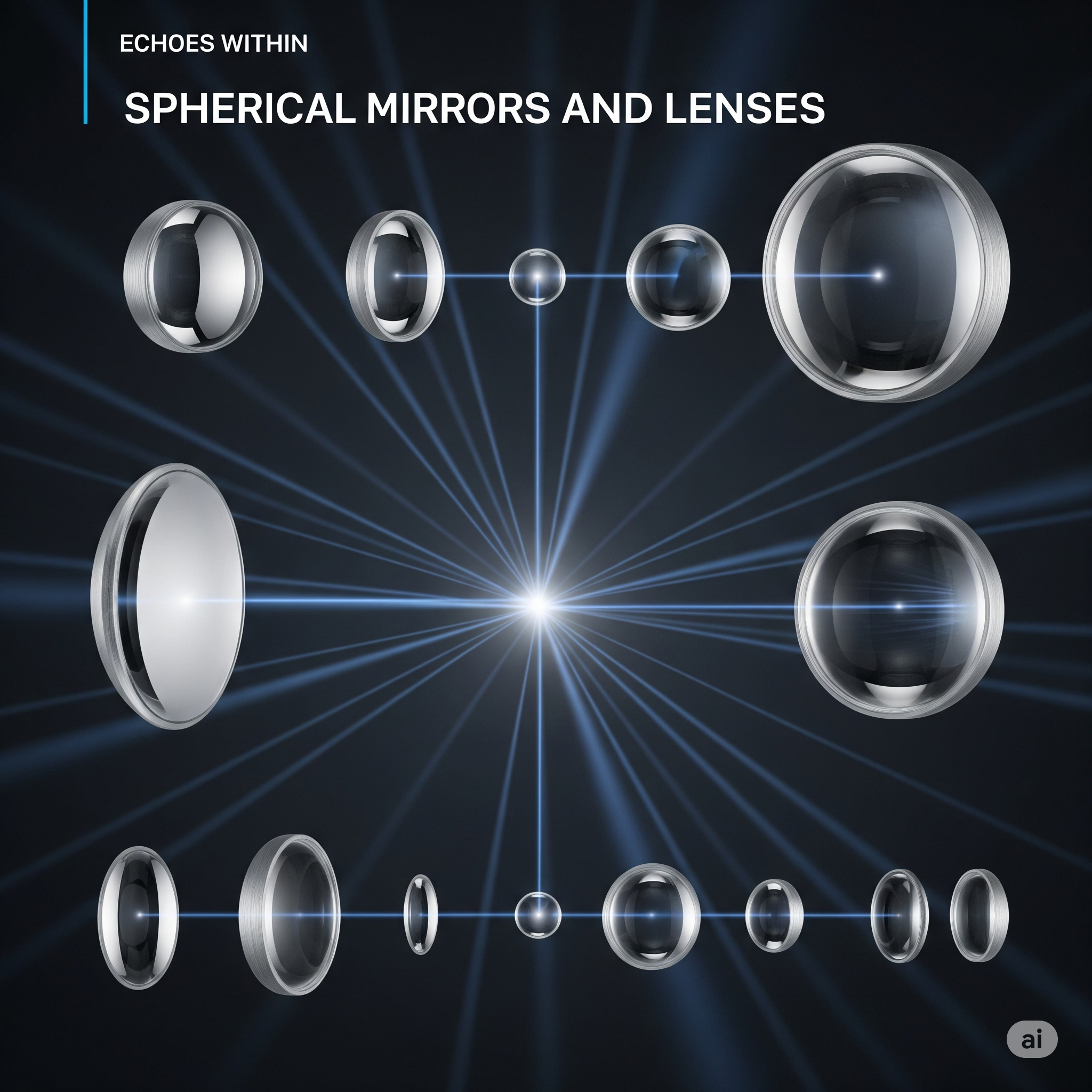
🔭 Summary Note: Light – Spherical Mirrors & Lenses
In Light 2, here is a clear and concise summary note for the lesson “Light – Spherical Mirrors & Lenses”, ideal for SEE-passed students preparing for NEB Grade 11 Science entrance exams.
🪞 Spherical Mirrors

🔹 Definition:
Spherical mirrors are parts of a sphere’s surface polished to reflect light.
🔸 Types:
Concave Mirror (Converging): The Reflective surface is curved inward
Convex Mirror (Diverging): The Reflective surface is curved outward
📌 Key Terms (Mirrors):
| Term | Description |
|---|---|
| Pole (P) | Centre of the mirror’s surface |
| Centre of Curvature (C) | Centre of the sphere of which the mirror is a part |
| Radius of Curvature (R) | Distance from pole to centre of curvature |
| Principal Axis | Line joining the pole and the centre of curvature |
| Focus (F) | Point where rays parallel to the axis converge (concave) or appear to diverge (convex) |
| Focal Length (f) | Distance between pole and focus (f = R/2) |
🔎 Image Formation by Concave Mirror (Rules):
Depends on the object’s position relative to F and C.
Image can be real/inverted or virtual/erect
Applications: torches, shaving mirrors, solar cookers
🔎 Image Formation by Convex Mirror:
Image is always virtual, erect, and diminished
Applications: rear-view mirrors in vehicles
📐 Mirror Formula:
1/f=1/v+1/u
Where:
f = focal length
v = image distance
u = object distance (sign conventions apply)
🔍 Spherical Lenses
🔹 Definition:
Lenses are transparent materials bounded by two spherical surfaces.
🔸 Types:
Convex Lens (Converging): Thicker at the centre
Concave Lens (Diverging): Thinner at the centre
📌 Key Terms (Lenses):
| Term | Description |
|---|---|
| Optical Centre (O) | Centre point of the lens |
| Principal Axis | A straight line passing through the optical centre |
| Focus (F) | Point where rays converge (convex) or appear to diverge (concave) |
| Focal Length (f) | Distance between the optical centre and the focus |
🔎 Image Formation by Convex Lens:
Depends on the object’s position
Can be real/inverted or virtual/erect
Used in magnifying glasses, cameras, and spectacles
🔎 Image Formation by Concave Lens:
Image is always virtual, erect, and diminished
Used in spectacles for myopia
📐 Lens Formula:
1/f=1/v−1/u
Magnification (M)=Height of image/Height of object=v/u
⚙️ Sign Conventions (for Mirrors & Lenses):
We should measure all distances from the pole (mirror) or the optical centre (lens)
Left side: negative, Right side: positive
We should always place the object on the left (u is negative)
🔍 You Can Also Read:
SEE Result: New Possibilities and Uncertainties for Students’ Future Careers in Nepal
How to Choose the Right Stream After SEE in Nepal
In conclusion, the concepts of reflection and refraction play a vital role in understanding how light behaves in different situations. As a result, students can now explain real-life phenomena such as mirages, rainbows, and optical illusions more clearly. In addition, Scientists and engineers widely apply these principles in instruments like mirrors, lenses, and optical fibres. Therefore, mastering them not only strengthens your foundation in physics but also prepares you for competitive entrance exams. So, you are now encouraged to revise key formulas, attempt MCQs, and explore practical examples to solidify your understanding.